Oct 8, 2026Project Planning
Why the Cheapest Lighting Supplier Is Not Always the Right Choice
The best lighting supplier is not always the cheapest. Learn how buyers can balance budget, quality, design, lead time and project requirements.

When buyers start sourcing lighting products, price is naturally one of the first things they compare.
But for many hotel, residential, and commercial lighting projects, the real question is not:
“Who can give me the lowest price?”
The more important question is:
“Which supplier can provide the right product for my project, within my budget, while meeting the required quality?”
These are two very different sourcing strategies.
A product that is cheaper at the quotation stage can sometimes become much more expensive later if it creates quality problems, delays, redesign costs, installation issues, or replacement claims.
For professional lighting procurement, the goal should be value and suitability — not simply the lowest unit price.
Price Is Only One Part of a Lighting Project
A lighting quotation may look simple: product, quantity, and unit price.
In reality, many other factors determine whether the product is suitable for a project.
These can include:
- Material and construction
- Finish quality
- Size and proportions
- Light source
- Color temperature
- Electrical components
- Certification requirements
- Packaging
- Installation method
- Replacement and maintenance
- Production lead time
- Shipping requirements
- Customization capability
Two lamps may look almost identical in a photograph but have very different internal structures, materials, and production standards.
For example, changing the thickness of metal, quality of a driver, type of socket, surface finishing process, or packaging structure can all affect the final price.
This is why comparing quotations only by unit price can be misleading.

The Right Product Should Match the Actual Application
Different projects require different standards.
A decorative table lamp for a residential project does not necessarily require the same construction as a lamp used in a hotel guestroom.
Hospitality lighting may need to consider:
- Frequent daily use
- Easy cleaning
- Stable electrical performance
- Replaceable components
- Commercial-grade installation
- Consistent finishes across large quantities
- Strong packaging for international shipping
In these situations, choosing a slightly more expensive product may reduce maintenance and replacement costs later. Working with an experienced hotel lighting supplier makes this trade-off easier to evaluate.
The same principle applies to residential developers, interior designers, contractors, and lighting distributors.
The product should first be evaluated according to where and how it will be used.
A Good Supplier Should Understand Your Budget
A professional supplier should not simply recommend the most expensive product.
The supplier should understand the buyer's target budget and then determine what specifications are realistic within that range.
For example, if a customer has a fixed project budget, there may be several ways to control cost without unnecessarily reducing quality:
- Adjusting material thickness where structurally acceptable
- Selecting a more practical finishing process
- Using standard components instead of fully customized parts
- Optimizing packaging
- Adjusting dimensions
- Choosing alternative materials with a similar appearance
- Consolidating products for more efficient shipping
This is very different from simply replacing everything with the cheapest available materials.
The objective is to optimize the product, not just reduce the price.
Quality Should Be Defined, Not Assumed
Another common problem in lighting sourcing is the word “quality.”
Different buyers can have very different expectations.
For one customer, quality may mean excellent surface finishing.
For another, it may mean long LED lifetime.
For a hotel operator, easy maintenance may be more important.
For an importer, certification and electrical compliance may be critical.
For a designer, color consistency and visual proportions may be the highest priority.
A reliable supplier should therefore clarify what “good quality” means for the specific project.
Important requirements should be confirmed before mass production whenever possible.
This may include:
- Drawings
- Finish samples
- Pre-production samples
- Electrical specifications
- Packaging requirements
- Installation details
Clear standards reduce misunderstandings between buyers and manufacturers.
The Lowest Price Can Carry Hidden Costs
A low quotation is attractive, but buyers should also consider the total cost of a sourcing decision.
Potential hidden costs can include:
Product Failure
Replacing defective lamps after installation can cost significantly more than the original product.
Production Delays
A supplier without adequate production control may affect the entire project schedule.
Color or Finish Inconsistency
For hotel and multi-unit residential projects, inconsistent finishes can become very noticeable after installation.
Poor Packaging
International transportation can easily damage glass, ceramic, marble, and other fragile lighting components if packaging is insufficient.
Difficult Maintenance
If LED modules, drivers, or electrical components cannot be replaced easily, a small component failure may require replacing the entire fixture.
Communication Errors
Misunderstood drawings, dimensions, finishes, or electrical requirements can create expensive rework.
For project sourcing, these risks should be considered together with the purchase price.

The Best Supplier Is Often the One Who Can Offer Options
Sometimes a buyer's original specification and target budget do not match.
A useful supplier should identify this early.
Instead of simply saying:
“The price is too low.”
A better approach is to provide alternatives.
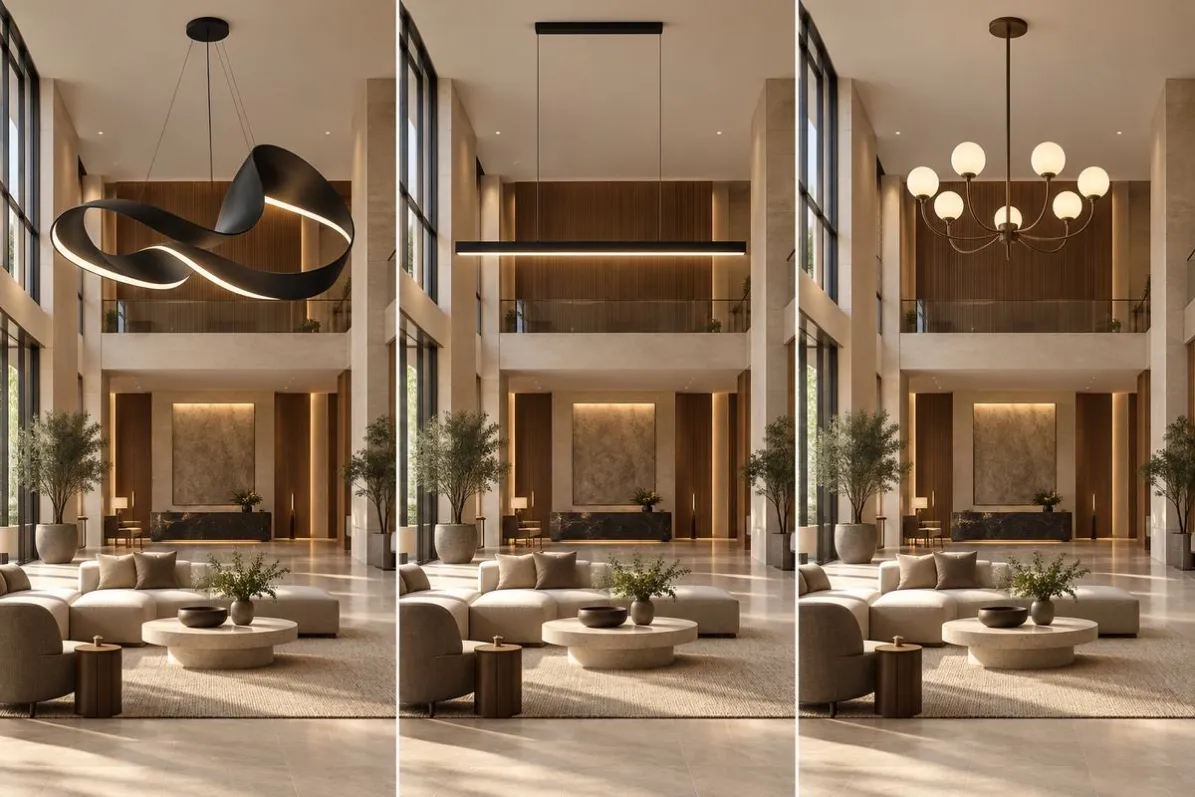
Option A — Original Specification
Maintain the requested materials, construction, and finish.
Option B — Cost-Optimized Version
Modify selected components while keeping the main appearance and function.
Option C — Higher-Performance Version
Upgrade components where reliability, compliance, or project requirements justify the additional cost.
This allows buyers to make informed decisions based on actual priorities.
It also makes procurement discussions much more efficient.

Supplier Selection Is About Balance For smaller volumes the trade-offs differ, as covered in our note on direct factory sourcing.
For most professional lighting projects, the ideal solution sits somewhere between the cheapest product and the highest specification available.
The correct balance depends on:
Budget + Design + Quality + Application + Lead Time + Compliance
A good sourcing partner should understand all six.
Price remains important, especially for large projects.
But price should be evaluated together with product suitability and project risk.
The best outcome is not necessarily the lowest quotation.
It is a product that:
- Meets the design requirement
- Performs reliably
- Fits the project budget
- Can be produced consistently
- Arrives within the required schedule
- Creates fewer problems after installation
That is what makes a lighting product genuinely cost-effective.
Looking for the Right Lighting Solution for Your Project?
At MOER Lighting, we work with hospitality, residential, and commercial lighting projects, helping buyers evaluate products based on design requirements, target budget, quality expectations, and production feasibility.
Rather than simply offering the cheapest available option, our goal is to help customers find a practical solution that fits the actual project.
If you are comparing lighting products or developing a custom lighting package, send us your specifications, reference images, quantities, and target budget.
We can help review the requirements and recommend suitable options.