Custom Lighting
Iron vs Stainless Steel for Hotel Lighting Fixtures: Frames & Finishes
Iron or stainless steel for hotel lighting? Compare costs, corrosion resistance, finishes and coastal suitability before choosing fixture frames.
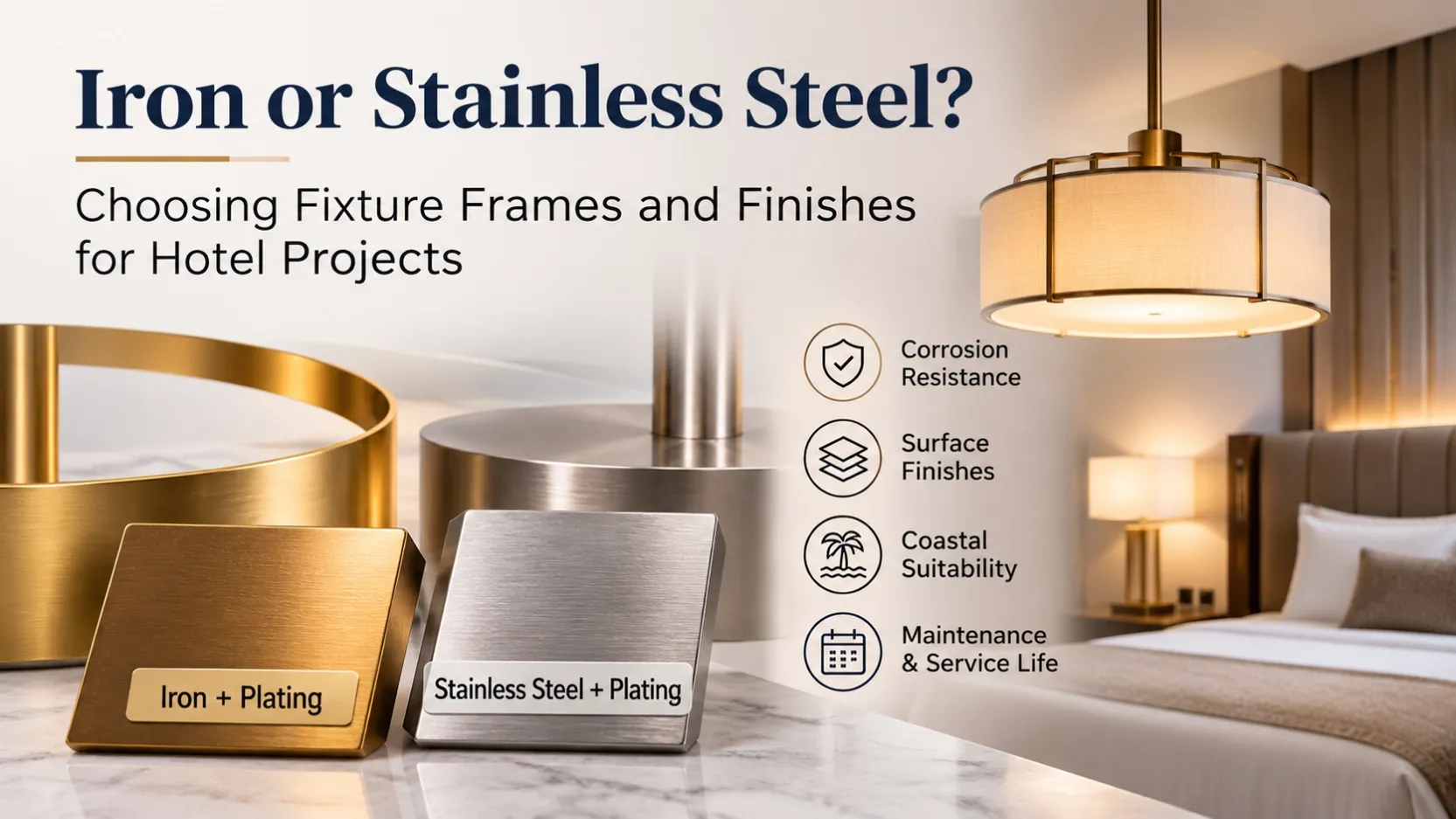
Choosing a metal frame for hotel lighting may seem straightforward. But the difference between iron and stainless steel can affect corrosion resistance, maintenance costs, finish appearance, and long-term performance.
A fixture that performs well in a dry, air-conditioned guestroom may deteriorate much faster in a humid hotel corridor or beachfront resort.
At MOER Lighting, we learned this through a hospitality project in the Philippines, where some lighting fixtures showed premature corrosion, internal condensation, and heat-related problems.
Since then, we have paid closer attention to hotel lighting frame materials, surface finishes, and environmental protection during project development.
This guide explains how we compare iron, stainless steel, and aluminum for decorative hotel lighting, and what buyers should confirm before production.
1. How Hotels Choose Lighting Frame Materials
For many hospitality lighting projects, the choice starts with three factors: budget, installation environment, and expected maintenance requirements.
In our project sourcing experience, the general selection pattern is:
- Value-focused hotels: Iron or mild steel frames with suitable decorative plating or protective coatings.
- Upscale hotels: Stainless steel frames where improved corrosion resistance and long-term appearance are priorities.
- Coastal hotels and resorts: Appropriate corrosion-resistant stainless steel grades and protective finishes, selected according to actual salt exposure.
Aluminum is another option, particularly for lightweight structures and LED housings that benefit from good heat dissipation.
However, material selection should never depend on hotel classification alone. A wall light inside a dry guestroom and a fixture beside an outdoor swimming pool can require very different construction, even within the same hotel.
2. Iron Frames: Economical and Flexible for Decorative Lighting
Iron and mild steel are widely used in decorative lighting because they offer good manufacturing flexibility at a relatively low cost.
They can be formed into curved arms, decorative frames, wall brackets, and other shapes commonly found in hotel guestrooms, restaurants, and public areas.
Advantages of iron frames
- Lower material cost compared with stainless steel.
- Suitable for bending, welding, and decorative fabrication.
- Compatible with various decorative finishes.
- A practical choice for many indoor hospitality lighting applications.
What are the limitations?
Iron is vulnerable to corrosion when its protective surface is damaged or insufficient.
Electroplating can create attractive finishes, including nickel, chrome, and selected decorative metallic effects. However, corrosion resistance depends on the complete finishing system rather than the decorative plating alone.
Plating thickness, surface preparation, protective layers, sealing treatments, and workmanship all influence durability.
In humid environments, problems may begin around scratches, weld seams, exposed edges, and areas where moisture accumulates.
Can iron be used in coastal hotels?
Yes, under suitable conditions, but additional protection may be necessary.
Depending on the design, a supplier may recommend an appropriate sealing treatment, protective coating, or improved surface preparation.
Oil-based sealing treatments may be used for certain finishing processes, but their effectiveness must be evaluated rather than assumed.
For beachfront properties with significant salt exposure, iron requires more careful assessment because repairs and replacements can increase long-term maintenance costs.
Our recommendation: Consider properly finished iron for dry, climate-controlled hotel interiors where cost efficiency is important. For aggressive coastal conditions, assess more corrosion-resistant alternatives.
3. Stainless Steel Frames: Better Corrosion Resistance for Demanding Hotel Environments
Stainless steel contains chromium, which forms a thin protective oxide layer on the surface.
This natural passive layer helps resist corrosion, making stainless steel a useful option for hotel lighting frames in humid or demanding environments.
Decorative surface treatments can provide the required appearance, but not every electroplating process automatically improves corrosion resistance.
The performance of the finished fixture depends on the stainless steel grade, surface preparation, coating compatibility, fabrication, and exposure conditions.
Why do hotel projects choose stainless steel?
- Better corrosion resistance than ordinary unprotected iron.
- Suitable for decorative lighting where long-term appearance matters.
- Available with different surface finishes.
- Useful for projects where fixture replacement is expensive or disruptive.
304 vs 316 stainless steel: What's the difference?
Two common stainless steel grades are 304 and 316.
304 stainless steel is widely used in indoor architectural and decorative applications. It offers good general corrosion resistance but can be susceptible to localized corrosion in chloride-rich environments.
316 stainless steel contains molybdenum, improving its resistance to chloride-related pitting corrosion. It is often a more suitable candidate for marine and coastal environments.
However, 316 stainless steel is not completely immune to corrosion. Surface condition, salt deposits, cleaning chemicals, fabrication quality, and maintenance still matter.
For hotel projects close to the sea or swimming pools, asking about the stainless steel grade is more useful than accepting the description "stainless steel" without further specifications.
What about decorative finishes?
Brass-colored, brushed nickel, chrome, and other metallic appearances can be incorporated into hotel lighting designs through different finishing processes.
For example, MOER's Modern Brass Oval Glass Globe Pendant Light SPP-2601 uses a decorative brass-finished metal frame around a white glass globe.
Another example is the Green Art Glass Wall Sconce SPW-2611, featuring a brushed nickel metal frame and layered decorative glass.
These examples show different metallic frame appearances for hotel interiors. Their standard product descriptions do not establish that the frames are stainless steel or that they are suitable for coastal exposure.
For a specific project, the base material, coating system, and environmental requirements should be reviewed and confirmed during specification and sampling.
4. Where Aluminum Fits in Hotel Lighting
Aluminum is lightweight, offers good thermal conductivity, and does not develop red rust like iron.
It can still corrode under certain conditions, especially when exposed to aggressive environments or incompatible materials.
Anodizing and suitable protective coatings can improve its surface performance.
Aluminum is particularly useful for:
- Certain LED housings and heat-dissipation components.
- Lightweight decorative structures.
- Designs requiring specific extrusion or casting processes.
- Applications where weight reduction is important.
It is not necessary to choose aluminum for every decorative hotel fixture. The final decision depends on the fixture design, production method, finish requirements, and environmental exposure.
5. Iron vs Stainless Steel vs Aluminum: Quick Comparison
Factor | Iron / Mild Steel | Stainless Steel | Aluminum |
|---|---|---|---|
Relative material cost | Lower | Higher | Varies by grade and fabrication |
Corrosion resistance | Depends heavily on protective finish | Generally better; grade matters | Good in many conditions; finish matters |
Decorative fabrication | Very flexible | Suitable for many designs | Design and process dependent |
Coastal suitability | Requires careful protection | Often preferred with suitable grade | Possible with appropriate design and coating |
Typical applications | Indoor decorative fixtures | Premium, humid and coastal projects | LED housings and lightweight fixtures |
Important: No metal offers a fixed corrosion-free service life under all conditions.
Actual performance depends on the material grade, finish system, fabrication details, installation environment, and maintenance.
6. What Determines How Long a Lighting Finish Lasts?
Two fixtures made from the same base metal can perform very differently.
The main reasons include:
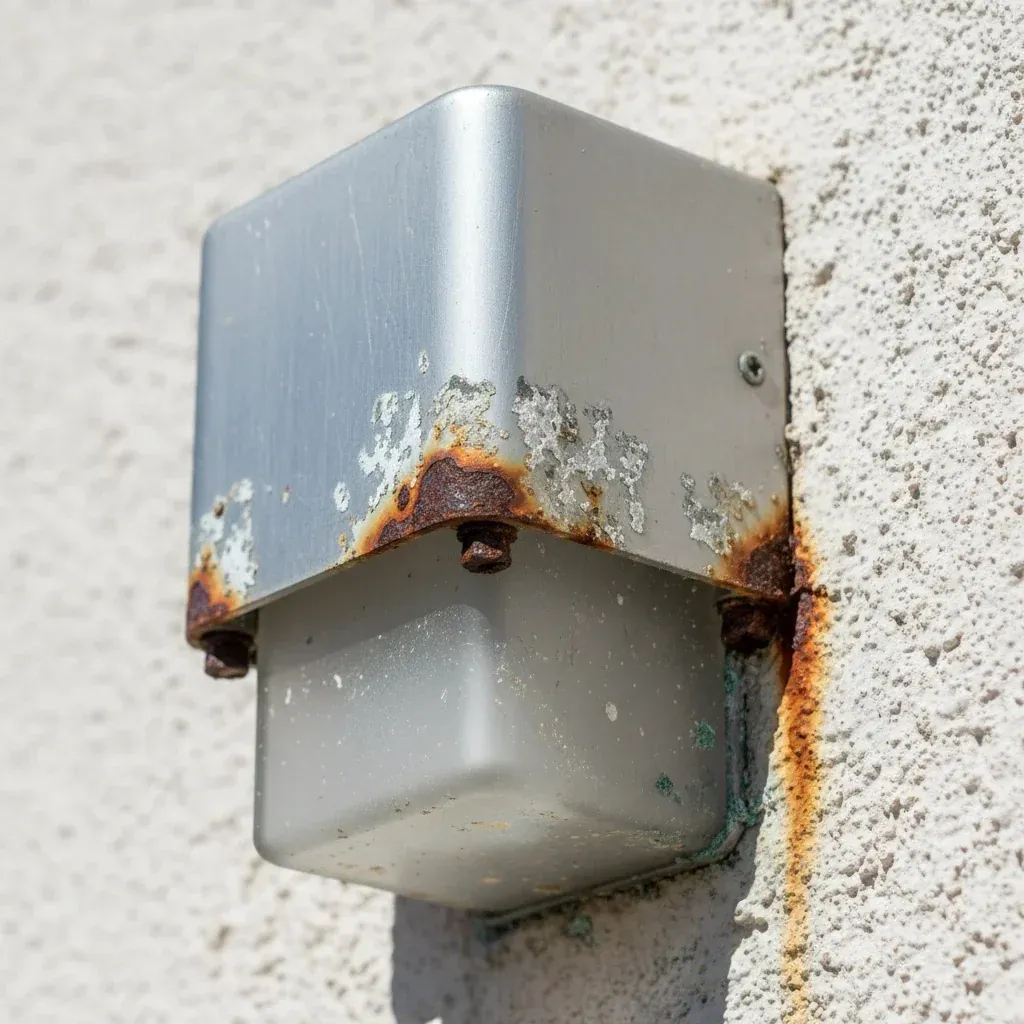
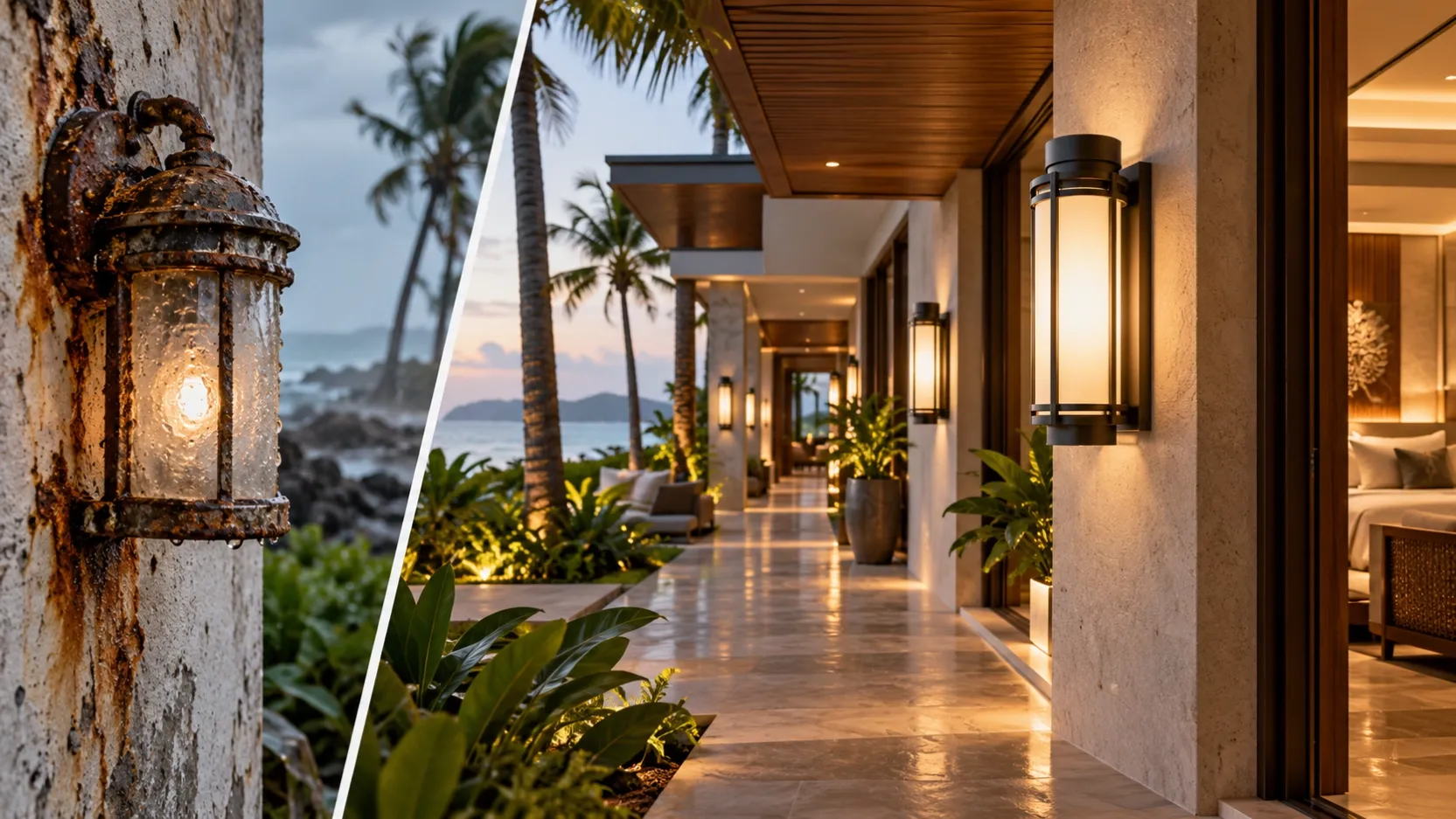
Example of corrosion and coating deterioration around the edges and fasteners of a metal lighting fixture. Actual corrosion resistance depends on the base material, protective finish, and installation environment.
Surface preparation and coating thickness
Proper cleaning and preparation help the protective finish adhere to the metal.
Coating thickness and the specific finishing process influence durability. A thicker layer is not automatically better unless the complete coating system is correctly designed.
Sealing and protective treatments
Certain plated iron components may benefit from additional sealing treatments.
The treatment should be compatible with the underlying finish and evaluated against the project's actual environmental conditions.
Weld seams, edges, and concealed surfaces
Corrosion can develop in areas that receive inadequate surface treatment.
Welded joints, cut edges, screw holes, and internal tube surfaces deserve particular attention during manufacturing and inspection.
Installation environment
Indoor guestrooms, humid corridors, open-air lobbies, beachfront terraces, and poolside spaces present different levels of exposure.
Cleaning and maintenance
Aggressive chemicals, abrasive cleaning tools, and prolonged salt deposits can damage finishes.
Maintenance instructions should match the material and surface treatment used.
7. Why Material Selection Alone Is Not Enough: Our Philippines Project Experience
Our Philippines hospitality project highlighted three related engineering challenges: corrosion, condensation, and heat accumulation.
Some fixtures experienced deterioration earlier than expected because their original material protection and housing design were not fully suited to the local environment.
That experience influenced how we review lighting specifications for tropical and coastal projects.
For the detailed project background, read our earlier article: Why Lighting Fixtures Fail in Tropical Climates: Lessons From a Philippines Hotel Project.
Salt spray testing
Salt spray testing is useful for evaluating selected aspects of corrosion resistance and comparing finishing systems under controlled conditions.
However, a particular number of test hours does not directly translate into a guaranteed number of years in a real hotel.
The test method, acceptance criteria, sample construction, and target environment should be established before testing.
Condensation management
Changes in temperature can create pressure differences inside lighting housings.
Where the design requires it, a suitable pressure-equalization vent may help manage pressure changes and reduce condensation risk.
Such components must be selected and validated for the actual enclosure design. They do not automatically eliminate moisture.
Heat dissipation
LED modules and drivers generate heat during operation.
A housing that is heavily sealed without adequate thermal management can expose components to excessive temperatures.
For tropical hotel projects, moisture protection and heat dissipation should be reviewed together.
Appropriate IP protection
IP ratings describe protection against solid objects and water ingress under defined test conditions.
For example, IP65 indicates dust-tight protection and resistance to water jets under specified testing conditions.
It does not establish corrosion resistance.
An indoor guestroom wall light may not require IP65, while fixtures in exposed or wet locations may need a higher level of ingress protection.
The final IP requirement should reflect the actual installation location and applicable project standards.
8. How to Choose Hotel Lighting Frames by Location
Dry, air-conditioned guestrooms
Properly finished iron or mild steel can be an economical choice.
For example, the Hotel Bedside Wall Light with USB SPW-2601 features a brushed nickel metal structure designed for dry indoor guestroom applications.
The specific metal grade and finishing system should be confirmed if a project requires additional environmental protection.
Humid hotel interiors
Consider stainless steel or a more robust protective finish when persistent humidity or condensation is expected.
The choice should reflect actual operating conditions, not just the country's general climate.
Coastal hotels and beachfront resorts
Evaluate suitable stainless steel grades, particularly 316 where chloride exposure justifies it.
Specify compatible finishes, corrosion-resistant hardware, and appropriate maintenance requirements.
Poolside, spa, and semi-outdoor areas
Evaluate chloride exposure, cleaning chemicals, water contact, and temperature changes.
Do not assume that a standard indoor decorative fixture is suitable for these locations simply because its metal frame looks corrosion-resistant.
9. Seven Questions to Ask Your Hotel Lighting Supplier
Before approving samples or placing a bulk order, confirm:
- What is the frame material, and what stainless steel grade is specified?
- Which decorative finishing process is used?
- What coating thickness and protective treatments are specified?
- Has the finish been tested against appropriate corrosion requirements?
- How are weld seams, exposed edges, and concealed surfaces protected?
- How does the housing manage moisture, condensation, and operating temperature?
- Is the specified IP rating appropriate for the installation environment?
These questions help hotel buyers compare quotations more accurately and reduce the risk of choosing fixtures based on appearance and initial price alone.
10. Choosing the Right Material Before Production
Iron and stainless steel are both useful for decorative hotel lighting, but they are not interchangeable in every environment.
For dry indoor spaces, properly protected iron may provide the best balance of cost and appearance.
For humid or coastal properties, an appropriate stainless steel grade and well-specified finish can offer a stronger starting point.
The most reliable decision considers the complete fixture: frame material, surface treatment, housing design, electrical components, installation location, and maintenance expectations.
At MOER Lighting, we support hotel and hospitality buyers with project-based material selection, sample confirmation, finish review, and production coordination.
If you are planning a hotel guestroom, resort, restaurant, or public-area lighting package, share your project location, fixture drawings, and intended applications.