Oct 8, 2026Success Stories
Why Lighting Fixtures Fail in Tropical Climates: Lessons From a Philippines Hotel Project
Why do lighting fixtures fail in tropical climates? A Philippines hotel project taught us how materials, corrosion protection, condensation control and thermal design affect fixture life.
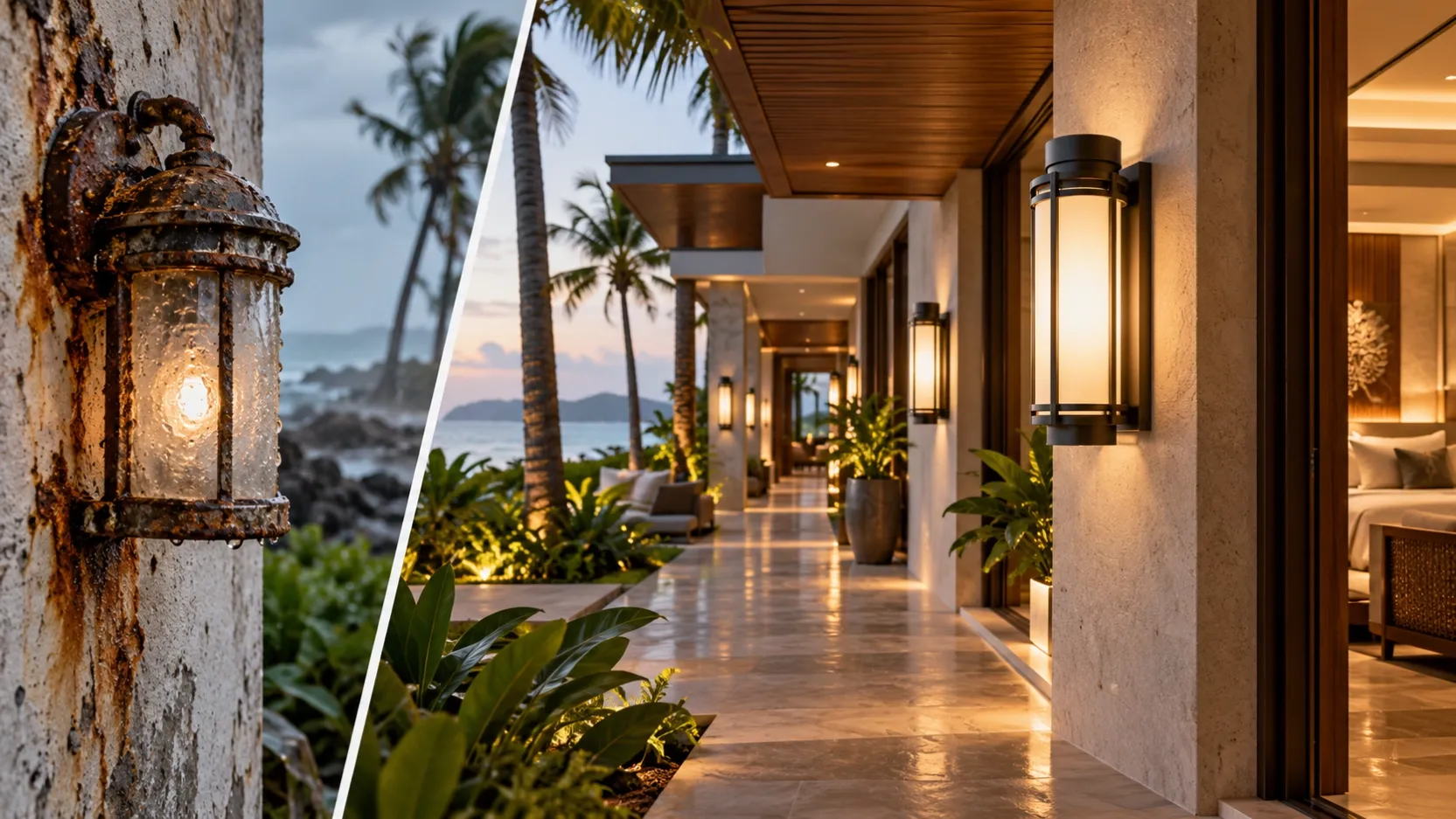
Some of the most useful engineering lessons come from projects that do not perform as expected the first time.
We learned one of those lessons from a hospitality lighting project in the Philippines.
After installation, several fixtures began showing signs of deterioration earlier than expected. The issue was not traced to one isolated component failure. The larger problem was that the original material, surface treatment, sealing, and thermal design were not robust enough for the actual installation environment.
That experience changed the way we evaluate lighting for tropical, humid, and coastal projects.
Today, when we work on hospitality lighting for Southeast Asia, the Gulf, coastal areas, poolside spaces, or other demanding environments, climate conditions are considered at the specification stage—not after installation.
What Was Different About the Environment?
Lighting that performs well in a dry, temperature-stable environment may behave very differently in a tropical climate.
In the Philippines, fixtures can be exposed to a combination of:
- High temperature
- High humidity
- Heavy seasonal rainfall
- Frequent temperature changes
- Salt-laden air in coastal locations
- Pool chemicals in resort environments
- Repeated cleaning and maintenance
- Air-conditioning cycles
These conditions affect more than the external appearance of a fixture.
They can influence the metal structure, coating system, seals, electrical components, LED modules, drivers, and even the air trapped inside the housing.
That is why simply choosing a fixture that “looks suitable for outdoor use” is not enough.
What We Observed
The main problems were related to three areas.
1. Accelerated Corrosion
Some metal components deteriorated faster than expected under prolonged humidity and salt exposure.
In humid or coastal environments, moisture, salt, scratches, joints, exposed edges, and coating imperfections can all increase corrosion risk.
2. Condensation Inside the Fixture
Moisture can appear inside a fixture even when the housing is designed to resist rainwater.
During the day, the air inside a fixture heats up and expands. At night, or when the surrounding temperature drops, the internal air cools and contracts.
This creates pressure differences between the inside and outside of the housing.
If the fixture cannot equalize this pressure properly, humid air may gradually enter through small gaps, seals, cable entries, or joints. Once inside, the moisture can condense as temperatures change.
A fixture does not automatically become moisture-proof simply by sealing it tighter.
3. Heat Accumulation
Moisture protection creates another engineering challenge: heat.
LED modules and drivers generate heat during operation. If a fixture is heavily sealed without sufficient thermal management, heat can accumulate inside the housing.
Higher operating temperatures can shorten the service life of LEDs, drivers, wiring, sealing materials, and other electronic components.
For humid environments, moisture protection and heat dissipation therefore need to be considered together.
What We Changed
Instead of treating the Philippines project as a one-off problem, we used it to improve how we specify fixtures for hot, humid, and coastal environments.
There is no single material or coating that works for every project. The correct protection system depends on the fixture material, installation location, design, and actual exposure conditions.
Several areas now receive much more attention during product selection and development.
1. Better Material Selection
For suitable tropical and coastal applications, we increasingly consider materials such as:
- Aluminum alloy
- Stainless steel
- Properly treated steel
- Corrosion-resistant fasteners and hardware
The correct choice depends on where the fixture will be installed.
A decorative table lamp inside an air-conditioned guestroom does not need the same construction as a wall light installed beside a resort swimming pool.
The important question is not simply:
“What material is the fixture made from?”
It is:
“Is this material and finish appropriate for the actual installation environment?”
2. Better Surface Protection Wall fixtures like this one are the positions where coating specification matters most.
Material selection alone is not enough.
Depending on the base material and application, corrosion protection may include:
- Surface pretreatment
- Powder coating
- E-coating
- Anodizing
- Stainless-steel surface treatment
- Multi-layer coating systems
E-coating can provide a more complete protective layer on suitable metal components, including areas that are difficult to reach with conventional spraying.
For aluminum parts, anodizing can improve surface hardness and corrosion resistance.
The exact process should always be selected according to the fixture design and application rather than applied as a fixed rule.
3. Salt Spray Testing
For projects with significant coastal or salt-air exposure, salt spray testing can help compare the corrosion resistance of different materials, finishes, coatings, fasteners, and components.
It is useful as a controlled comparison tool before production.
However, salt spray hours should not be treated as a direct formula for predicting an exact number of years of real-world service, because actual performance is also affected by UV exposure, installation conditions, cleaning methods, scratches, chemicals, and maintenance.
4. Pressure Equalization and Condensation Control
One of the most important changes was paying more attention to pressure equalization inside sealed housings.
For suitable outdoor and moisture-exposed fixtures, a breathable pressure-equalization vent can help manage internal pressure changes while reducing the risk of liquid water and contaminants entering the housing.
This can lower stress on seals and help reduce internal condensation.
It is especially useful for fixtures exposed to strong daytime heat, cooler nighttime temperatures, rain, humidity, or large temperature changes.
5. Improved Heat Dissipation
Better sealing should not come at the expense of thermal performance.
For LED fixtures, heat must be transferred away from the LED module and driver effectively.
Depending on the design, this may involve better aluminum structures, improved contact with heat-dissipation surfaces, more suitable driver positioning, or better internal component layout.
The objective is simple: protect the fixture from moisture without allowing excessive heat to build up inside.
6. Better Protection at Vulnerable Points
Water and moisture do not only enter through the main body of a fixture.
Small construction details often determine long-term reliability.
These include:
- Cable entries
- Wire exits
- Screws
- Joints
- Gaskets
- Glass interfaces
- Driver compartments
- Connectors
7. Aging and Environmental Testing
That does not tell us how it will behave after extended operation.
For suitable projects, aging and environmental testing can help identify problems related to heat buildup, driver stability, LED performance, sealing, moisture, and electrical connections.
Finding these problems before shipment is much less expensive than finding them after hundreds of fixtures have already been installed.
8. Selecting the Correct IP Rating
IP rating is important, but it should match the actual installation location.
For example:
- A decorative guestroom lamp may not require a high IP rating.
- A bathroom fixture may need additional moisture protection.
- A covered outdoor corridor may require a different level of protection.
- A poolside or landscape fixture may need IP65 or higher depending on exposure.
For outdoor, semi-outdoor, poolside, landscape, and other moisture-exposed hospitality applications, IP65 is one of the protection levels we commonly evaluate.
But IP rating alone does not guarantee long-term durability.
A fixture can have a high IP rating and still suffer from corrosion, poor heat dissipation, unsuitable materials, or internal condensation if other engineering details are overlooked.
Tropical Lighting Is a System, Not a Single Specification
One of the biggest lessons from this project was that there is no single “tropical-proof” material or coating.
Reliable lighting in demanding climates depends on several factors working together:
Material + surface treatment + sealing + pressure management + thermal design + electrical protection + testing + installation environment
Improving only one factor may not solve the problem.
For example, switching from steel to aluminum can improve corrosion resistance, but it does not automatically solve condensation or thermal issues.
The entire fixture system needs to be considered.
What Buyers Should Ask Before Ordering For large statement pieces in an entrance volume, our sculptural pendant guide covers scale decisions separately.
If you are sourcing lighting for a hotel, resort, commercial property, or residential project in a tropical, humid, or coastal region, ask your supplier these questions before production:
- What is the base material, and is it suitable for the actual installation environment?
- What surface treatment or corrosion protection is being used?
- How is condensation and internal pressure managed?
- What IP rating is appropriate for the real installation location?
- How is heat from the LED module and driver dissipated?
- Has the proposed material or finish been tested for the expected environment?
These questions are much easier to answer before production than after installation.
Why This Matters Before Production
Environmental requirements are easier—and much cheaper—to address before production begins.
Changing materials, coatings, sealing structures, drivers, fasteners, or venting systems after installation can be costly and disruptive.
For hospitality projects, it may also involve removing fixtures from guest rooms, public areas, façades, or landscape installations.
The best time to discuss tropical-climate protection is during product selection and engineering review.
What We Learned
The Philippines project changed the way we approach lighting for demanding climates.
Instead of asking only whether a fixture can be manufactured, we now pay much more attention to where it will actually be installed and what environmental conditions it needs to survive.
For tropical and coastal hospitality projects, this can affect everything from the base material to the smallest cable entry.
The lesson was simple:
A lighting fixture should be designed for its environment—not just for its appearance.
Planning a hotel or commercial lighting project in a hot, humid, or coastal climate?
Send us the project location and application—guestroom, lobby, bathroom, spa, poolside, façade, landscape, or other area—and we can review the material, finish, IP protection, and environmental requirements before production.