Oct 8, 2026Project Planning
Custom Lighting Manufacturing Process | From Design to Delivery | MOER Lighting
Learn how a custom lighting project moves from concept and sampling to production, QC, certification, packaging and final shipment.
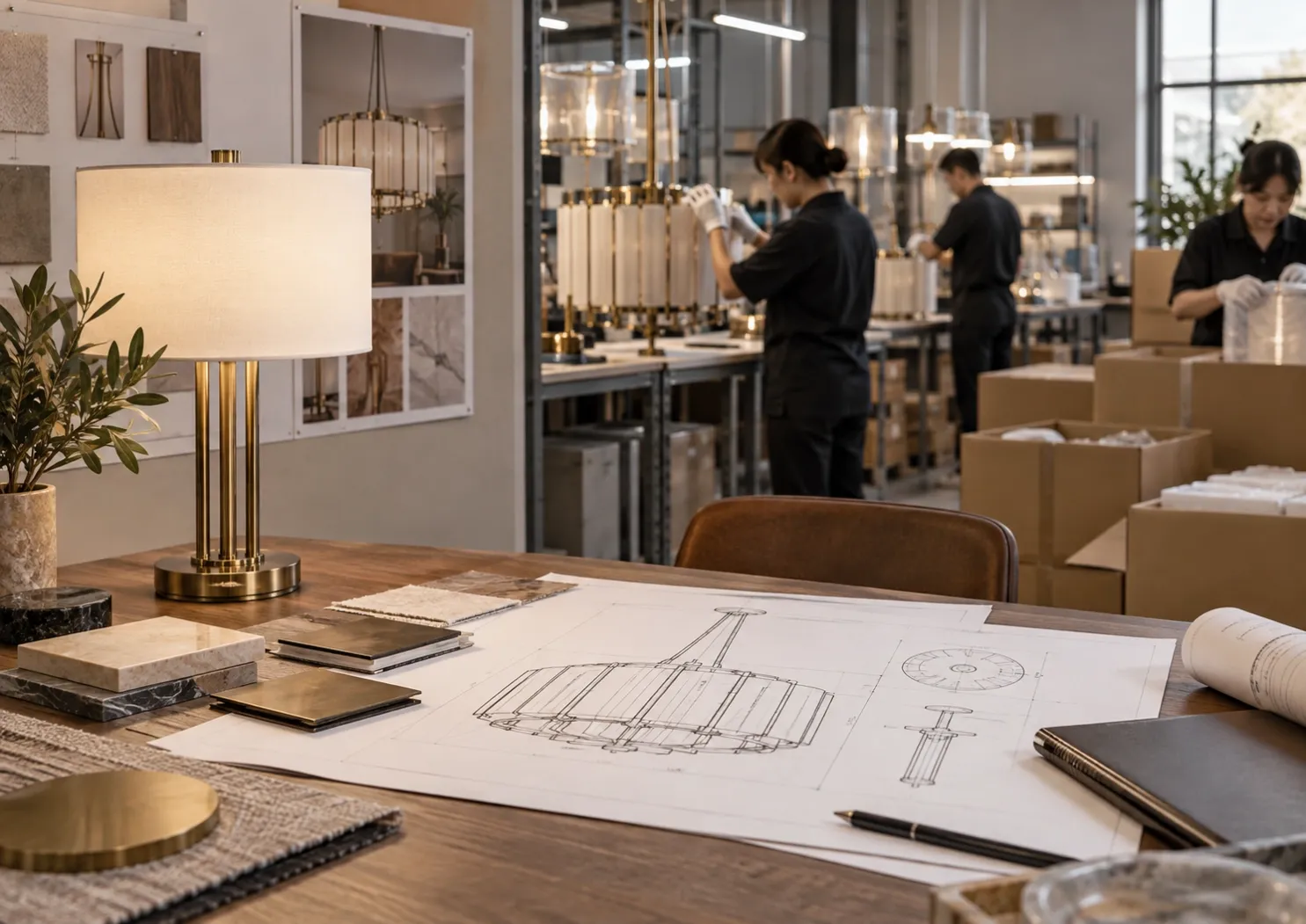
If you've never sourced custom lighting from overseas before, the process can feel like a black box.
You send a reference image, drawing, or design concept, confirm a deposit, and then wait. But what is actually happening on the other end? When will you see a sample? What happens if the finish isn't quite right? And how do you make sure the final production matches what you approved?
At MOER Lighting, we work with hotel developers, interior design studios, lighting distributors, and project buyers across North America, Europe, the Middle East, and Southeast Asia.
One of the most common questions from new clients is simple:
“What happens after I send you my lighting brief?”
Here is how a typical custom lighting project moves from an initial concept to finished production and shipment.
Step 1: Understanding the Project Brief The specification decisions that feed into this process are covered in our custom hotel lighting overview.
Every project starts with understanding the requirement, not simply quoting a price.
The more information we have at the beginning, the easier it is to avoid unnecessary revisions later.
Useful information includes:
- Reference images, CAD drawings, sketches, or design concepts
- Application, such as hotel guestrooms, lobbies, restaurants, retail spaces, or residential projects
- Approximate order quantity
- Target budget range
- Required dimensions and materials
- Preferred finish and color
- Target destination market
- Project schedule
The destination market is particularly important because electrical systems, safety standards, labeling, energy-efficiency requirements, and import procedures can vary from one market to another.
For example, a fixture designed only for a 120V electrical system may not be suitable for a 220–240V market. Likewise, certification and documentation requirements for North America may be different from those required in Europe, Saudi Arabia, or Southeast Asia.
Identifying these requirements early helps prevent costly redesigns later in the project.
For smaller project buyers, the right sourcing model is just as important as the product itself. We have also explained why small B2B buyers do not always need direct factory sourcing and how a sourcing partner can help manage mixed products, lower quantities, and project risk.
Step 2: Design & Engineering
Once the design direction is clear, the concept needs to be translated into something that can actually be manufactured.
Our technical team works with the appropriate production engineers to confirm details such as:
- Overall dimensions
- Materials
- Finish and color
- Light source
- Wattage
- CCT (color temperature)
- Dimming requirements
- Driver specifications
- IP rating where required
- Mounting method
- Structural support
- Weight load
- Electrical configuration
CCT should be confirmed early because it has a major influence on the final atmosphere of a space. For hospitality projects, you can also read our guide on why 2700K warm lighting is becoming a preferred choice for hotels and luxury homes.
For custom lighting projects, this is also the stage where we identify potential production challenges.
A design may look simple in a rendering but require special tooling, custom glass, unusual metalwork, or a different construction method in production.
It is better to identify these issues before sampling begins rather than after tooling or production has already started.
Step 3: Sampling
Once the key specifications are confirmed, we move into sampling.
A complete technical drawing is helpful, but it is not always required to start the conversation. Some projects begin with a CAD drawing, while others begin with a reference image, rendering, photograph, or even a rough sketch.
We help turn that information into a workable product specification.
For most projects:
- Typical sampling time: approximately 7–14 working days
- Sample quantity: one piece per design is normally sufficient
- Sample pricing: typically around 2× the quoted bulk unit price, depending on the design, materials, and tooling requirements
If the project proceeds to bulk production, one unit's value can normally be credited back against the production order. This means the effective sample cost becomes approximately one production unit once the bulk order is confirmed.
Not every project requires a complete fixture sample.
This is especially important because product photos alone cannot fully show actual lighting quality, finish, or color, which is why physical samples remain an important part of B2B lighting approval.
If the buyer only needs to confirm a specific detail, we may recommend sending:
- Finish swatches
- Metal samples
- Ceramic color samples
- Glass samples
- Fabric or shade materials
- Electrical components
This can be faster and more cost-effective than producing an entire fixture just to verify one detail.
Step 4: Sample Review & Revision
The sample is where the design becomes real.
At this stage, the buyer can evaluate:
- Dimensions
- Finish
- Color accuracy
- Material quality
- Light output
- CCT
- Construction
- Installation method
- Overall appearance
Color should also be reviewed under the intended lighting conditions. This is particularly important for ceramic fixtures, because ceramic lighting colors can look noticeably different under different light sources.
For fully customized products, it is normal for the first sample to require adjustments.
The purpose of sampling is not simply to produce a finished-looking piece. It is to identify and correct problems before they are repeated across an entire production run.
Depending on the project, one or two rounds of revision may be required.
Once the final sample or pre-production sample is approved, it becomes the reference standard for bulk production.
This is the point where all major details should be confirmed before production begins.
Step 5: Order Confirmation & MOQ
After sample approval, we confirm the final production specifications, quantity, price, packaging requirements, and production schedule.
For many project lighting designs, MOER can support production quantities starting from approximately 10–20 pieces per design.
However, MOQ depends on the product.
Certain designs may require higher quantities or additional setup costs because of:
- Custom glass molds
- Special ceramic production
- Custom casting
- Unique metal tooling
- Specialized finishes
- Custom electrical components
- Material supplier minimums For smaller volumes the trade-offs differ, as covered in our note on direct factory sourcing.
When tooling or special processes are required, we identify the cost and quantity implications before production is confirmed.
This is particularly important for boutique hotels, small renovation projects, and mixed-product orders where quantities may be relatively low.
Step 6: Production & Quality Control
After the order is confirmed and all required details are approved, production begins.
For standard project lighting orders, production lead time is typically around 30–35 days, although more complex custom products may require additional time.
Quality control is carried out throughout the production process rather than only after everything has been completed.
Typical checks include:
Initial Production Check
Early production units are compared against the approved sample or confirmed specifications before the main production run proceeds.
This helps catch problems before they are repeated across the full quantity.
In-Process Inspection
During production, spot checks may cover:
- Dimensions
- Finish consistency
- Components
- Assembly
- Wiring
- Light source
- Structural details
Pre-Shipment Inspection
Before packing and shipment, the finished products are checked again.
Depending on the fixture, inspection may include:
- Function testing
- Visual inspection
- Finish and color consistency
- Electrical components
- Assembly
- Packaging
- Quantity verification
Different materials also require different inspection methods. For example, our guide on spray-coated glass lampshade quality inspection explains how finish consistency, scratches, coating defects, and overall appearance can be checked before shipment.
For custom project lighting, the approved sample and confirmed specifications remain the primary reference throughout production.
Step 7: Certification & Compliance
Certification and compliance requirements vary by product type and destination market.
Depending on the project, requirements may involve:
- Electrical safety
- Product testing
- Energy efficiency
- Labeling
- Technical documentation
- Product registration
- Import documentation
- Shipment conformity documentation
For North American projects, this may involve certification to applicable UL or ETL safety standards.
For European projects, CE and RoHS compliance may be relevant depending on the product and applicable regulations.
For Saudi Arabia and other Middle Eastern markets, requirements may involve product registration, conformity assessment, IECEE-related documentation, energy-efficiency requirements, SABER procedures, or other market-specific requirements depending on the product category.
Rather than assuming that every fixture entering a country requires exactly the same certification, we review the product type and destination first.
MOER can help coordinate the process between the client, factory, testing laboratory, certification body, and importer where required.
As standard practice, third-party testing and certification costs are normally covered by the client.
For larger project-based orders, certification costs and commercial terms can be discussed on a case-by-case basis.
Step 8: Packaging & Logistics
Lighting fixtures are often fragile, irregular in shape, and sensitive to scratches, impact, and moisture.
Packaging therefore needs to be considered as part of the product rather than as an afterthought.
Depending on the fixture, packaging may include:
- Molded foam or protective inserts
- Reinforced corners
- Separate protection for glass or crystal components
- Inner boxes
- Export cartons
- Wooden crates or pallets
- Moisture protection for sea freight
The packaging method also needs to balance product protection with shipping volume.
Oversized packaging may reduce damage risk but significantly increase freight cost, so both factors need to be considered together.
Depending on the quantity, destination, and project schedule, shipments may move by:
- Sea freight
- Air freight
- Courier
- Consolidated shipment
Sea freight is normally more cost-effective for larger project orders, while air freight or courier may be more suitable for samples, replacement parts, or urgent quantities.
We can also coordinate the export documents required for shipment and customs clearance.
Step 9: Delivery & After-Sales Support
Once the goods arrive, we recommend checking the shipment against the packing list and inspecting the cartons for visible transport damage.
If a product arrives damaged or does not match the approved specification, the issue should be documented with clear photographs or video so the cause can be identified quickly.
Depending on the situation, after-sales support may include:
- Replacement components
- Replacement glass or shades
- Spare drivers or LED modules
- Installation guidance
- Technical troubleshooting
- Replacement products where appropriate
Warranty terms, replacement-part responsibility, and damage-handling procedures should be confirmed before shipment so both sides understand how any post-delivery issues will be handled.
For project lighting, good after-sales support is not only about replacing a damaged fixture.
It is also about making sure maintenance remains practical after installation.
Frequently Asked Questions
How long does a custom lighting sample take?
For most standard custom lighting designs, sampling takes approximately 7–14 working days after the specifications are confirmed.
More complicated products involving new molds, custom glass, ceramic production, or specialized components may require additional time.
Is there a minimum order quantity for samples?
Normally, no.
A single sample per design is standard for project evaluation and approval.
How much does a lighting sample cost?
Sample pricing is typically around 2× the quoted bulk unit price, depending on the design and production requirements.
If the project proceeds to bulk production, one unit's value can normally be credited back against the order.
If you only need to confirm a finish, color, material, glass texture, or another specific detail, a smaller material or component sample may be a faster and more economical option.
What is the minimum order quantity for custom lighting?
For many project lighting products, quantities can start from approximately 10–20 pieces per design.
However, products requiring custom molds, specialized materials, casting, glass production, or other tooling may require higher quantities or additional setup costs.
How long does bulk production take?
Standard production normally takes approximately 30–35 days after the final sample and production specifications are approved.
Highly customized products may require longer lead times.
Do you support small hotel or renovation projects?
Yes.
Many project buyers do not need hundreds of pieces of the same design.
For boutique hotels, guestroom renovations, restaurants, residential projects, or smaller commercial projects, we can evaluate lower quantities and mixed-product requirements on a project-by-project basis.
Can I start with only a reference image?
Yes.
A project can start from a CAD drawing, specification sheet, rendering, reference image, photograph, or rough sketch.
The important first step is understanding the required dimensions, application, quantity, destination market, and design intent.
Who pays for certification?
Third-party testing and certification costs are normally the client's responsibility.
For larger projects, certification costs and commercial terms can be discussed separately depending on the order and market requirements.
What happens if my project timeline changes?
Let us know as early as possible.
The greatest flexibility normally exists before raw materials are purchased, tooling is completed, or production begins.
Once materials have been customized or production has started, changes may affect both cost and lead time.
Have a Lighting Concept in Mind?
You do not need a complete technical drawing to start.
Send us your:
- CAD drawing
- Reference image
- Rendering
- Specification
- Material requirement
- Or even a rough sketch
We can review the concept, identify potential production or compliance issues, and recommend the most practical next step — whether that is a finish swatch, material sample, prototype, or complete lighting sample.
MOER Lighting — Lighting & Sourcing Made Simple.