Oct 8, 2026Custom Lighting
2700K Isn’t Just a Number: What “Warm Light” Actually Means for a Hotel Project
2700K alone does not guarantee consistent hotel lighting. Learn how CCT, CRI, SDCM, dimming and shade materials affect the final result.
“Warm light” appears in almost every recent hospitality lighting discussion.
But for a hotel project, warm light is not just a mood. It is a specification.
Simply writing “2700K warm white” on a specification sheet does not guarantee that every finished fixture will look the same once installed.
For hotel guestrooms, corridors, lobbies and restaurants, several details matter: CCT, CRI, color consistency, dimming behavior, and the material surrounding the light source.
2700K and 3000K Are Not the Same
Color temperature is measured in Kelvin. Lower values appear warmer.
For hospitality projects, two values are especially common:
- 2700K — warmer and slightly more amber. Often used for guestrooms, bedside lamps, lounges, bars and other spaces where relaxation is the priority.
- 3000K — still warm, but slightly cleaner. Often used for lobbies, reception areas, corridors and other spaces where more visual clarity is useful.
A hotel does not need to use one color temperature everywhere.
For example:
Area | Typical Starting Point |
|---|---|
Guestroom | 2700K |
Bedside lighting | 2700K |
Lounge / bar | 2700K |
Lobby | 3000K |
Reception | 3000K |
Corridor | 3000K |
Bathroom vanity | 3000K |
These are starting points, not fixed rules.
What matters most is that fixtures seen together look consistent.
A corridor intentionally designed at 3000K beside a 2700K guestroom is one thing. Two bedside lamps that are both specified as 2700K but visibly look different are another.
CRI Matters Too
CCT tells you whether the light is warm or cool.
It does not tell you how accurately colors will appear under that light.
That is where CRI — Color Rendering Index — becomes important.
A 2700K light source with poor color rendering may still make skin tones, fabric, wood or stone look dull or unnatural.
For guestrooms, lobbies and other finish-sensitive hospitality spaces, CRI 90+ is a useful project target.
This is especially relevant when the interior includes materials such as:
- natural wood;
- stone;
- brass or bronze;
- decorative fabrics;
- ceramic;
- colored glass.
The hotel may invest heavily in these finishes, so the lighting should allow them to appear as intended.
The Detail Buyers Often Miss: SDCM
Two LEDs can both be labeled 2700K and still look slightly different.
This happens because LED production naturally produces small variations in color.
Manufacturers sort LEDs according to how closely their color points match. This is commonly described using SDCM — Standard Deviation of Color Matching.
The simple rule is:
The lower the SDCM number, the tighter the color consistency.
For hotel projects where several fixtures are viewed together, SDCM 3 or tighter is a useful target to discuss with the supplier.
This is particularly relevant for:
- corridor wall lights;
- repeated guestroom fixtures;
- multiple pendants installed together;
- large quantities of the same decorative fixture.
Wider tolerances allow more variation between units.
That does not automatically mean the product is defective, but it increases the possibility that two fixtures installed next to each other may not look exactly the same.
This is why a specification that only says:
“2700K”
may still be incomplete for a large hotel project.
For repeated fixtures, it is worth asking about color consistency and production-batch control, not only nominal CCT.
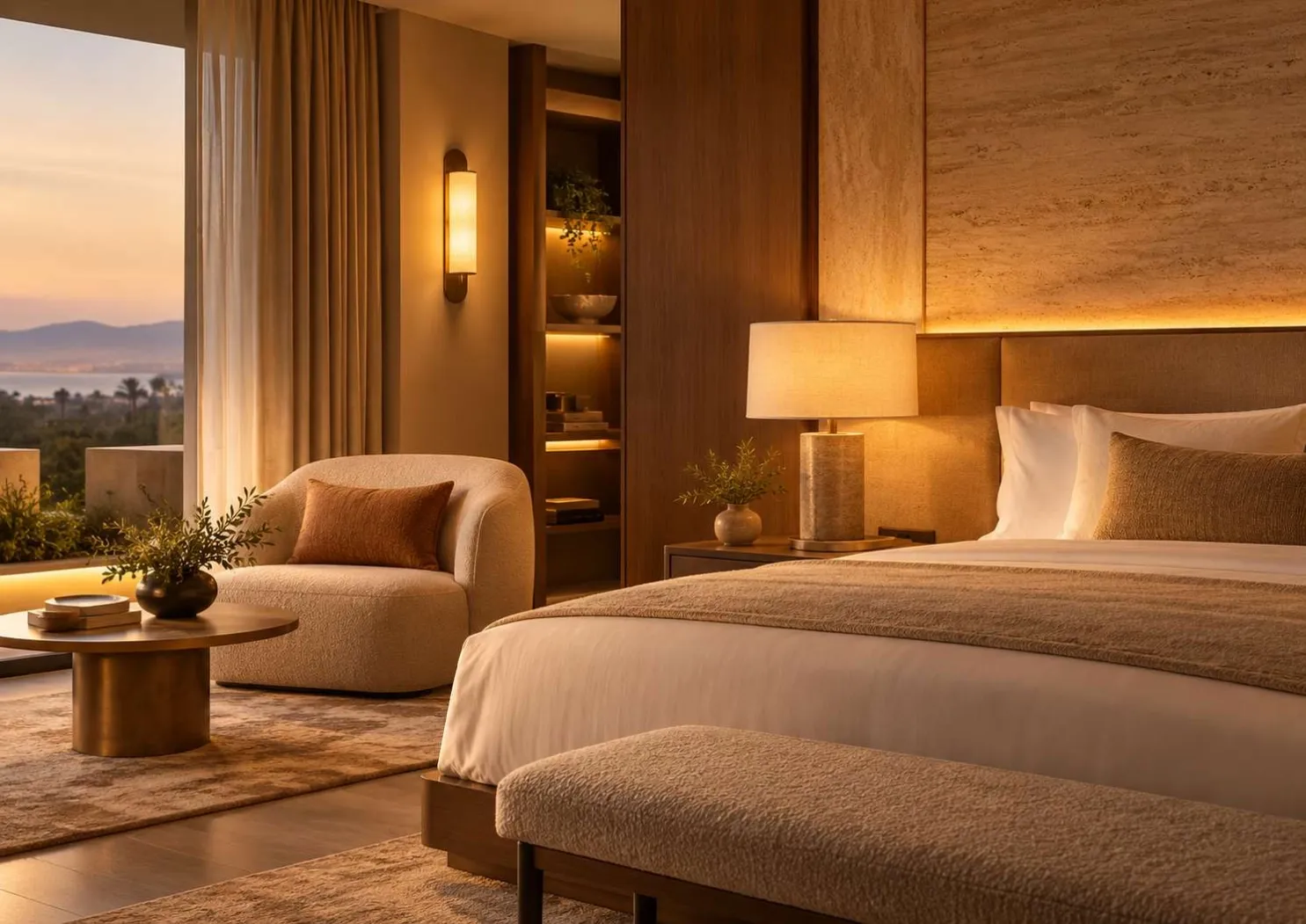
Warm Light Changes Once It Passes Through the Fixture Table lamps such as this one show the color difference most clearly at low output.
The LED itself is only one part of the finished lighting effect.
The material around it also matters.
Fabric Shades
Fabric absorbs and filters light.
The same 2700K LED behind white linen can look different from the same LED behind a darker, thicker or more textured fabric.
Glass and Acrylic
Clear, frosted and tinted materials transmit and diffuse light differently.
Frosted glass or acrylic can slightly change the perceived color and distribution of the light depending on the material, thickness and diffuser construction.
Metal and Interior Finishes
Warm light also changes how surrounding materials are perceived.
Brass, bronze, wood and warm neutral finishes often work naturally with 2700K–3000K lighting.
The important point is simple:
The LED specification and the finished visual effect are not automatically the same thing.
For decorative hotel lighting, the final shade, glass or diffuser should ideally be checked during sampling.
Standard Dimming and Dim-to-Warm Are Different
These two functions are sometimes confused.
Standard Dimming
The brightness changes, but the color temperature stays approximately the same.
A 2700K fixture remains around 2700K as it becomes brighter or dimmer.
Dim-to-Warm
Both brightness and color temperature change.
As the light is dimmed, it becomes warmer, creating an effect closer to traditional incandescent lighting.
For example, a fixture may operate around 2700K at higher output and move toward a warmer tone at low output.
Dim-to-warm requires the correct LED light source, driver and control compatibility.
It can be useful in areas such as:
- hotel bars;
- lounges;
- restaurants;
- other spaces where the atmosphere changes between daytime and evening.
It is not automatically necessary for every hotel fixture.
A simple guestroom table lamp, for example, may only need reliable standard dimming.
What Should a Complete Warm-Light Specification Specification details are easier to confirm against a real fixture, such as this decorative floor lamp.Include?
For a hotel project, instead of writing only:
Warm White — 2700K
consider confirming these five items:
- CCT2700K or 3000K, selected according to the space.
- CRICRI 90+ can be used as a project target for guest-facing and finish-sensitive areas.
- Color consistencyDiscuss SDCM and production-batch consistency when many identical fixtures will be installed together.
- Dimming behaviorConfirm whether the project requires standard dimming or dim-to-warm.
- Actual shade and diffuserCheck the finished fixture because fabric, glass and acrylic can affect the final appearance of the light.
None of these requirements is particularly complicated.
But together, they provide much more useful information than a one-line note saying:
“2700K warm white.”
Confirm It During Sampling Why 2700K is becoming the default choice across hotel categories is covered separately.
For custom hotel lighting, the sampling stage is the best time to confirm these details.
The buyer can check:
- whether the color temperature is correct;
- whether several fixtures look consistent;
- whether the CRI meets the project requirement;
- how the shade or diffuser affects the light;
- whether dimming works correctly;
- and whether the final effect matches the intended interior.
For guestrooms, color temperature is only one part of nighttime comfort. Light level, fixture position and control also matter. You can also read our guide to Sleep-Friendly Guestroom Lighting.
At MOER Lighting, we work with hospitality buyers and designers during the sampling stage to confirm lighting specifications before mass production, including CCT, CRI, light source, dimming requirements, shade materials and production consistency.
If you are sourcing decorative lighting for a hotel project, contact MOER Lighting to discuss your drawings, quantities and lighting specifications.