Oct 8, 2026Hospitality Lighting
Sleep-Friendly Hotel Bedroom Lighting: When Less Light Means Better Sleep
Good hotel bedroom lighting is not just about smart controls. Learn how warm light, layered lighting and better nighttime control can reduce sleep disturbance.
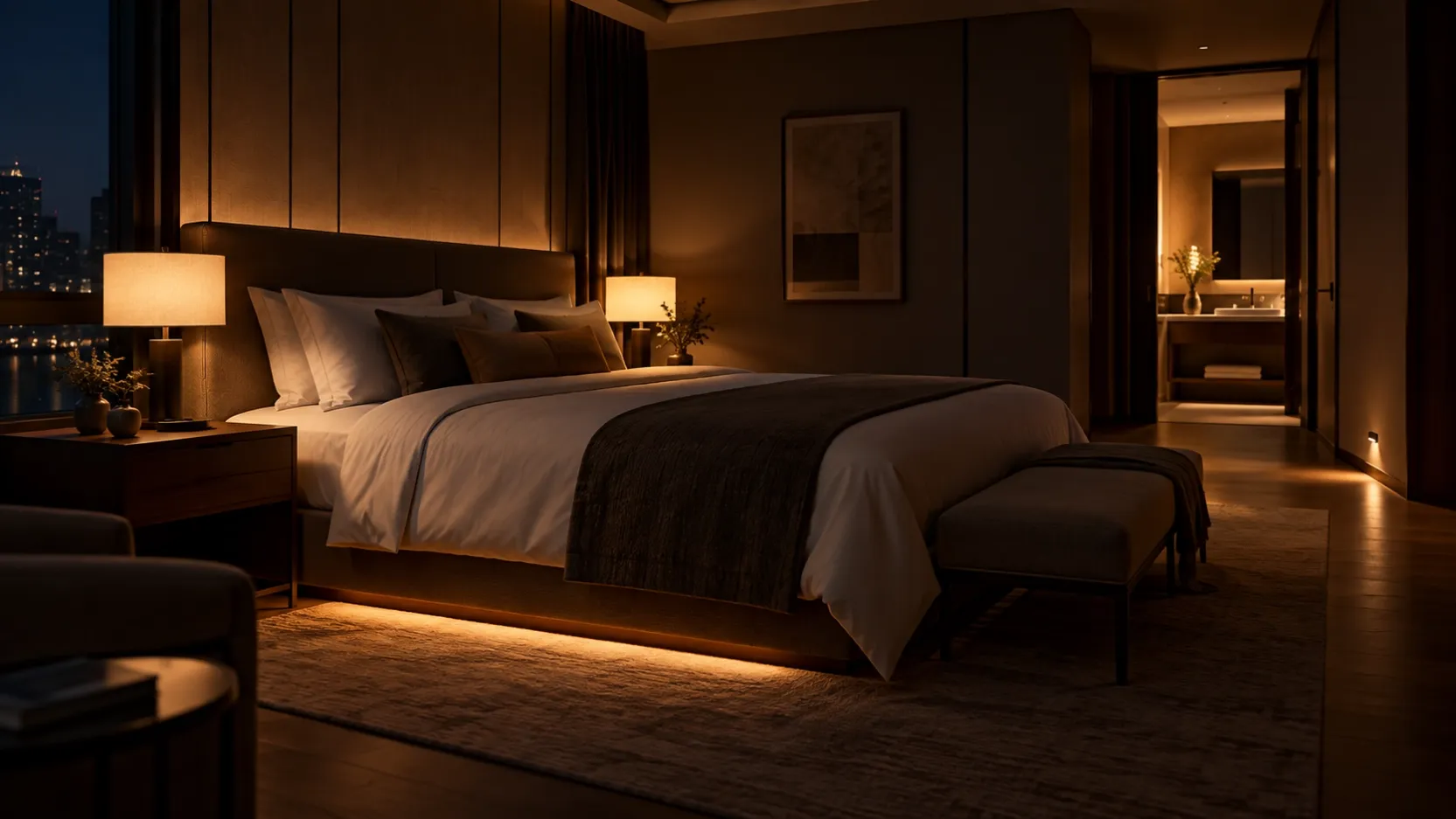
Hotel bedroom lighting is often designed around convenience.
Guests need enough light to enter the room, unpack luggage, read in bed, use the bathroom at night, and prepare for the next morning. Motion sensors, automatic night lights, and smart controls can make these activities easier.
But sleep-friendly lighting raises a different question:
What happens when lighting designed to help one guest disturbs another guest who is already asleep?
As guest wellbeing becomes more important in hospitality design, good bedroom lighting is not simply about adding more functions.
Sometimes, better lighting means using less light.
Sleep-Friendly Lighting Is More Than Warm Color Temperature
Warm lighting is an important part of hotel bedroom design.
For many guestrooms, 2700K warm lighting can create a softer and more relaxing atmosphere in the evening.
However, color temperature is only one part of the guest experience.
A sleep-friendly room should also consider:
- brightness;
- light direction;
- fixture position;
- timing;
- individual control;
- and whether the room can become genuinely dark during sleep.
A warm light can still become unwanted light if it turns on at the wrong time.
For hotel guestrooms, the question should therefore not only be:
“What color temperature should we use?”
It should also be:
“Does this light need to be on at all?”
A Practical Problem With Automatic Night Lighting
During hotel stays, I have noticed a practical problem with some automatic bedside and under-bed lighting systems.
The idea behind these systems is reasonable.
When a guest gets out of bed at night, a motion sensor detects movement and automatically switches on a low-level light.
This can help the guest walk safely toward the bathroom without turning on the main room lighting.
For the person getting out of bed, this can be convenient.
But the experience can be very different for another person who is still sleeping.
If two people share the same room, one person may only need to place their feet on the floor or walk beside the bed for the sensor to activate.
The light may not be very bright.
But in an otherwise completely dark bedroom, even a relatively small amount of light can become noticeable.
For guests who prefer sleeping in complete darkness or who are particularly sensitive to light, this automatic lighting may interrupt their sleep.
The issue becomes even more obvious in rooms shared by couples, families, or children.
One person may need to get up during the night, while everyone else still needs darkness.
This raises an important question for hospitality lighting design:
Should every nighttime movement automatically create light?
Not necessarily.
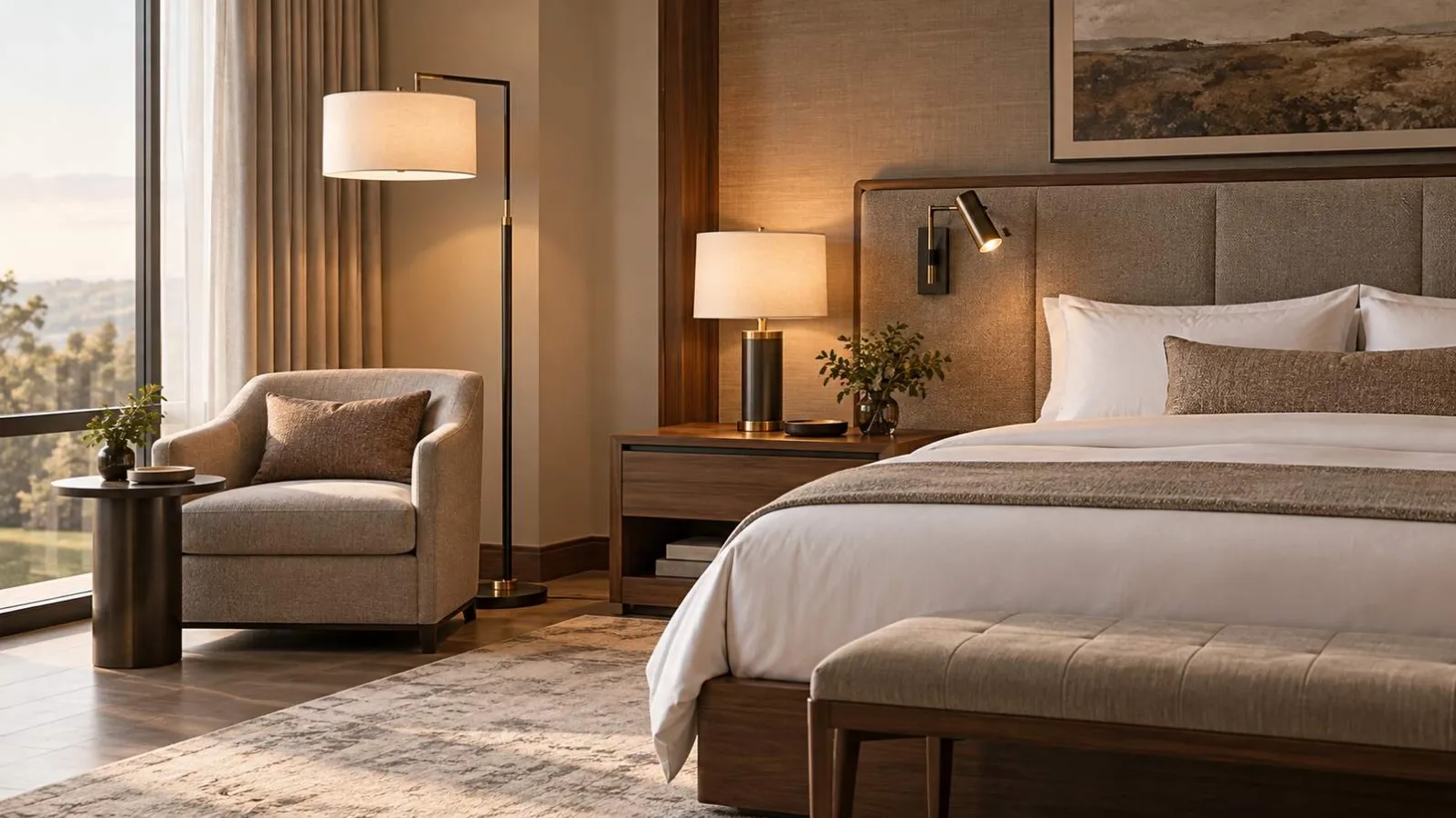
1. Use Warm, Dimmable Lighting Before Sleep A bedside source such as this table lamp is specified for exactly this reason.
A hotel guestroom has very different lighting requirements throughout the day.
A guest may need relatively bright lighting when unpacking luggage, working at a desk, or preparing in the morning.
Later in the evening, the same level of brightness may feel unnecessary.
This is where dimmable lighting becomes useful.
Bedside wall lamps, table lamps, floor lamps, and ambient fixtures can allow guests to gradually reduce the amount of light in the room instead of moving directly from bright lighting to complete darkness.
The objective is not simply to make a room look warmer.
It is to allow guests to choose the amount of light they actually need.
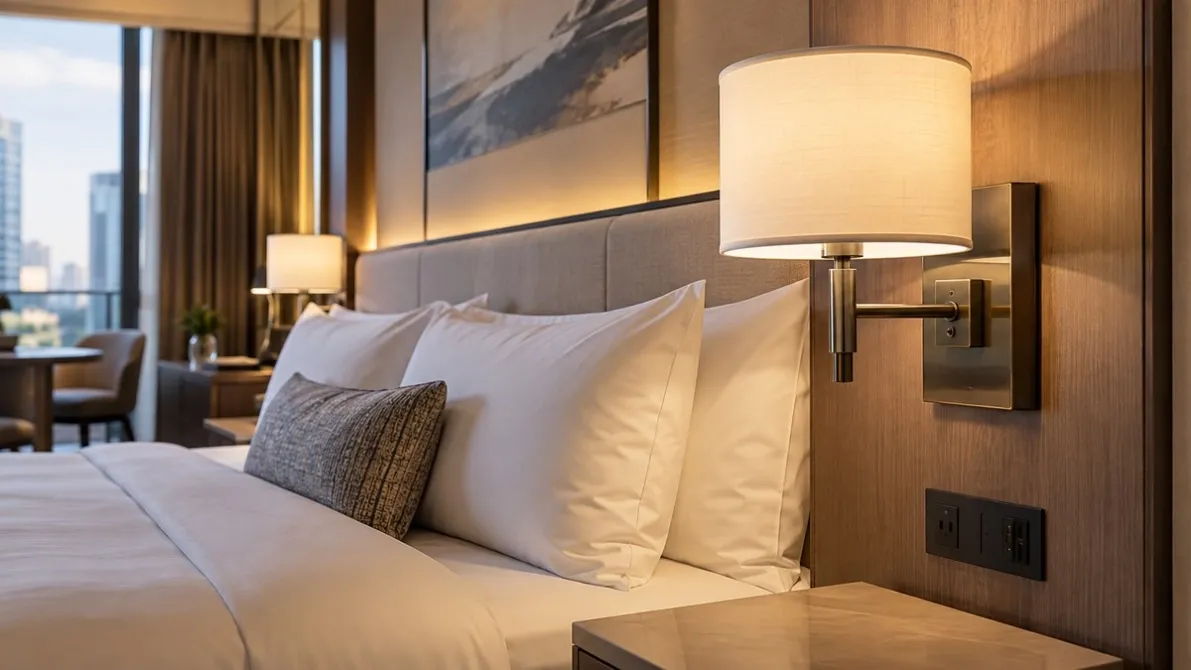
2. Separate Lighting Into Different Layers A wall sconce like this one adds reading light without occupying the bedside surface.
A hotel bedroom should not depend entirely on one central ceiling light.
Different activities require different lighting.
Ambient Lighting
General lighting helps guests enter the room, unpack luggage, and move comfortably around the space.
Bedside Lighting
Bedside wall lamps or table lamps can provide local lighting without illuminating the entire room.
Reading Lighting
A directional reading light allows one guest to read while limiting unnecessary light on the other side of the bed.
Decorative Lighting
Wall sconces, pendants, table lamps, and indirect lighting can create atmosphere without requiring high overall brightness.
Night Navigation Lighting
Very low-level lighting can help guests move safely toward the bathroom during the night.
The purpose of layered lighting is simple:
Give guests the light they need without turning on light they do not need.
3. Night Lighting Should Guide the Path, Not Light the Bedroom
Nighttime lighting has a very different purpose from normal room lighting.
Its job is not to illuminate the bedroom.
Its job is simply to provide enough visibility for safe movement.
For this reason, night lights can often work better when positioned close to floor level.
Possible locations include:
- underneath the bed;
- near the skirting board;
- along the path toward the bathroom;
- close to the bathroom entrance.
Keeping the light source low can help reduce direct light reaching the eyes of someone who is still sleeping.
This creates an important design principle:
Illuminate the path, not the room.
A guest getting up at 2:00 a.m. usually does not need the entire bedroom to become visible.
They only need enough light to move safely.
4. Motion Sensors Need Better Logic, Not Just More Sensitivity
Motion sensors can be useful in hospitality lighting.
The problem is not necessarily the sensor itself.
The problem is what happens after movement is detected.
If the detection area is too large or too sensitive, the light may activate every time someone changes position near the bed.
A better design should consider several factors.
Detection Area
Does the sensor really need to detect movement throughout the entire bedside area?
A more focused detection zone may reduce unnecessary activation.
Trigger Position
Where does the guest actually need light?
In many cases, detecting movement toward the bathroom may be more useful than detecting every movement beside the bed.
Brightness
The triggered light should provide only the minimum level required for safe movement.
Duration
The light should not remain on longer than necessary.
A short activation period may be enough for nighttime navigation.
Manual Override
Guests should also be able to disable automatic nighttime lighting completely.
This is particularly important for people who strongly prefer sleeping in a fully dark room.
Automation should provide convenience.
It should not remove control from the guest.
5. Give Guests a True “All Off” Option
One of the simplest functions in a hotel bedroom can also be one of the most useful:
a button that actually turns everything off.
Not almost everything.
Everything.
Small light sources can become surprisingly noticeable in a dark room.
These may include:
- decorative LEDs;
- switch indicators;
- bedside control lights;
- illuminated USB outlets;
- automatic accent lighting;
- equipment standby lights.
During the daytime, these details may appear insignificant.
At night, they can become much more noticeable.
Guests who prefer complete darkness should therefore have a simple way to create it.
A bedside master switch or clearly defined Sleep Mode can sometimes improve the guest experience more than adding another complicated automatic function.
Smart Lighting Should Serve the Guest
Smart lighting has clear advantages in hospitality projects.
It can improve convenience, support energy management, and simplify room operation.
The issue is not whether hotel lighting should be smart or non-smart.
The more important question is:
Does the technology improve the actual guest experience?
Sometimes automation should turn a light on.
Sometimes good lighting design means allowing the light to remain off.
This becomes particularly important when two or more people share the same bedroom.
One person's movement should not automatically change the sleeping environment for everyone else.
Better Sleep Does Not Always Require More Technology
A hotel does not necessarily need a highly complex lighting control system to create a more sleep-friendly guestroom.
Many improvements can come from relatively straightforward design decisions:
- warm evening lighting;
- dimmable fixtures;
- independent bedside controls;
- directional reading lights;
- layered lighting;
- low-positioned navigation lights;
- carefully positioned motion sensors;
- shorter activation periods;
- manual sensor override;
- and a true all-off option.
These solutions may appear simple.
But they address a fundamental part of the guest experience:
Different guests need different amounts of light at different times.
And when someone is actually sleeping, sometimes the best light is no light at all.
For hotel designers, buyers, and lighting suppliers, this changes the question from:
“How many lighting functions can we add?”
to:
“How can we provide light exactly where it is needed without disturbing the people who do not need it?”
That may be one of the most practical ways to approach sleep-friendly hotel bedroom lighting.
Planning a Hotel Guestroom Lighting Project? Our guestroom category guide covers how bedside, seating and ceiling layers work together.
MOER Lighting supports hospitality buyers, designers, distributors, and project sourcing teams with guestroom lighting including bedside wall lamps, reading lights, table lamps, floor lamps, and custom decorative fixtures.
Our focus is not simply on supplying individual lamps, but on helping buyers coordinate lighting specifications, samples, finishes, electrical requirements, production, and quality control around the actual project.
If you are developing a hotel guestroom lighting package and need support with fixture selection, customization, or project specifications, contact MOER Lighting to discuss your project.