Oct 8, 2026Hospitality Lighting
Choosing the Right Lighting Categories for a Hotel Guestroom
How table lamps, floor lamps, sconces, ceiling lights and mirrors work together in a coordinated guestroom scheme.

A hotel guestroom is one of the most repeated spaces in a property, so a lighting specification that looks reasonable in a single room can be expensive across a whole floor. The categories are simple — table lamps, floor lamps, wall sconces, ceiling lights and mirrors — but the decisions that determine whether a room feels restful or busy are made inside each category. This guide covers how to layer those categories and what to confirm before ordering.
Layer the Room by Function
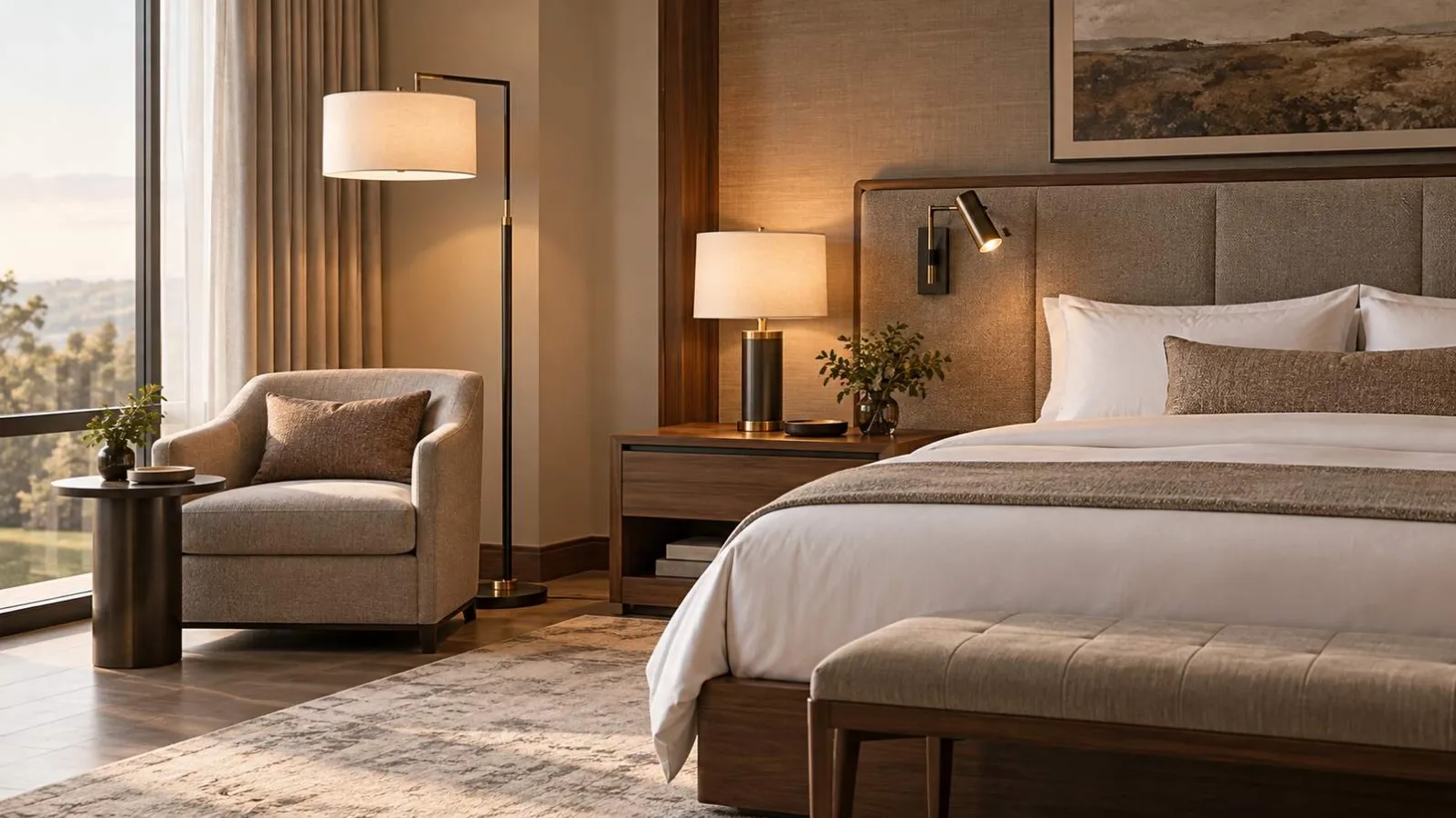
A guestroom typically needs more than one source of light. Bedside fixtures support reading and local control. Floor or desk lamps add task light in the seating area. Ceiling fixtures support general illumination and the room's overall brightness. The goal is a coordinated set of functions rather than the maximum number of decorative fixtures.
A practical way to check a room is to stand in it at three points: at the bedside, in the seating area, and in the middle of the floor. Each should offer a usable light level for what happens there. If one point is bright and another has nothing, the room will feel uneven no matter how the specification reads on paper.
Hospitality table lamps and floor lamps cover most of the task and ambient needs at these positions; ceiling fixtures then only have to carry general illumination, which lets the lower-level fixtures stay where they are needed.
Keep Repeated Details Consistent
Finish tone, shade color, switch style and visible hardware can connect different fixture categories into one specification. A consistent specification also makes sampling and room-to-room installation easier to manage, because installers handle the same components in the same way on every floor.
Consistency does not mean every fixture is identical. It means the visible elements that a guest touches or notices — the switch, the shade edge, the stem finish — repeat across categories. A common failure is specifying a coordinated pendant and sconce in one finish while the bedside table lamp arrives in a visually different finish, which reads as an error rather than a design choice.
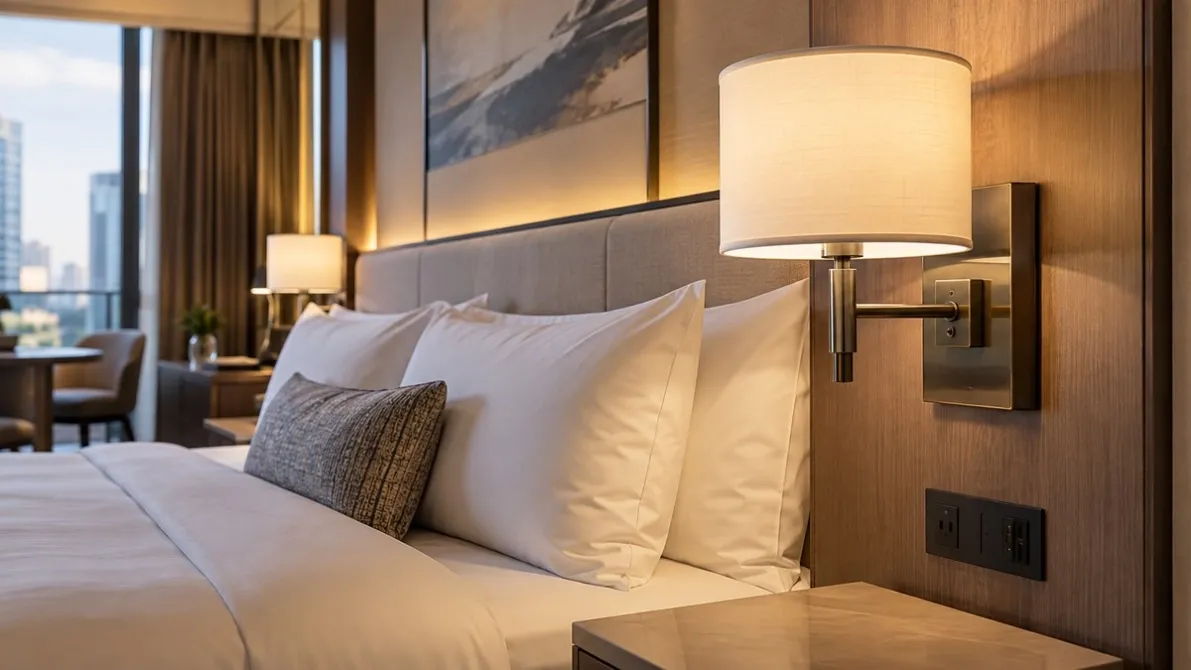
For walls beside the bed, wall sconces can serve reading light without occupying the bedside surface, which matters in smaller rooms where a table lamp competes with a phone, a clock and a glass of water.
Plan Light Levels for Sleeping and Waking
Guestrooms are used at two very different times of day. A room that is comfortably bright in the evening can still be too bright to sleep in, and a room that is dim enough to sleep in will frustrate a guest who needs to work. This is usually solved by separating the lighting into layers rather than by dimming everything together.
One practical layer is a low, warm source near the bed for the last hour of the evening, plus a controllable main source for general use. Whether that warm layer comes from a dedicated reading fixture or from the bedside lamp depends on how the room is used and what the operator prefers to maintain. Our guide to sleep-friendly hotel bedroom lighting covers this layering in more detail.
Light quality matters as much as level here. Warm color temperature is the usual specification for bedside and guestroom lighting, but the number alone does not guarantee consistency — rendering quality, shade material and lamp variation all affect how a room reads. Our note on what 2700K actually means for a hotel project explains the parameters that matter beyond the color temperature code.
Coordinate Bathroom Areas An illuminated mirror like this one is the fixture a guest uses most predictably in the room.
For bathroom areas, coordinate the LED mirror size and light effect with the vanity layout and surrounding finishes. Mirror lighting is often treated as a separate decision from the rest of the room, but it is the fixture a guest uses most predictably and most often — it is what determines whether someone can do their hair properly after a long flight.
The common error is specifying mirror size before layout. A mirror narrower than the vanity, or positioned so that light falls on one side of the face only, is a detail that is expensive to change after installation because the wall has usually already been tiled.
Check Ceiling Fixtures Against the Ceiling
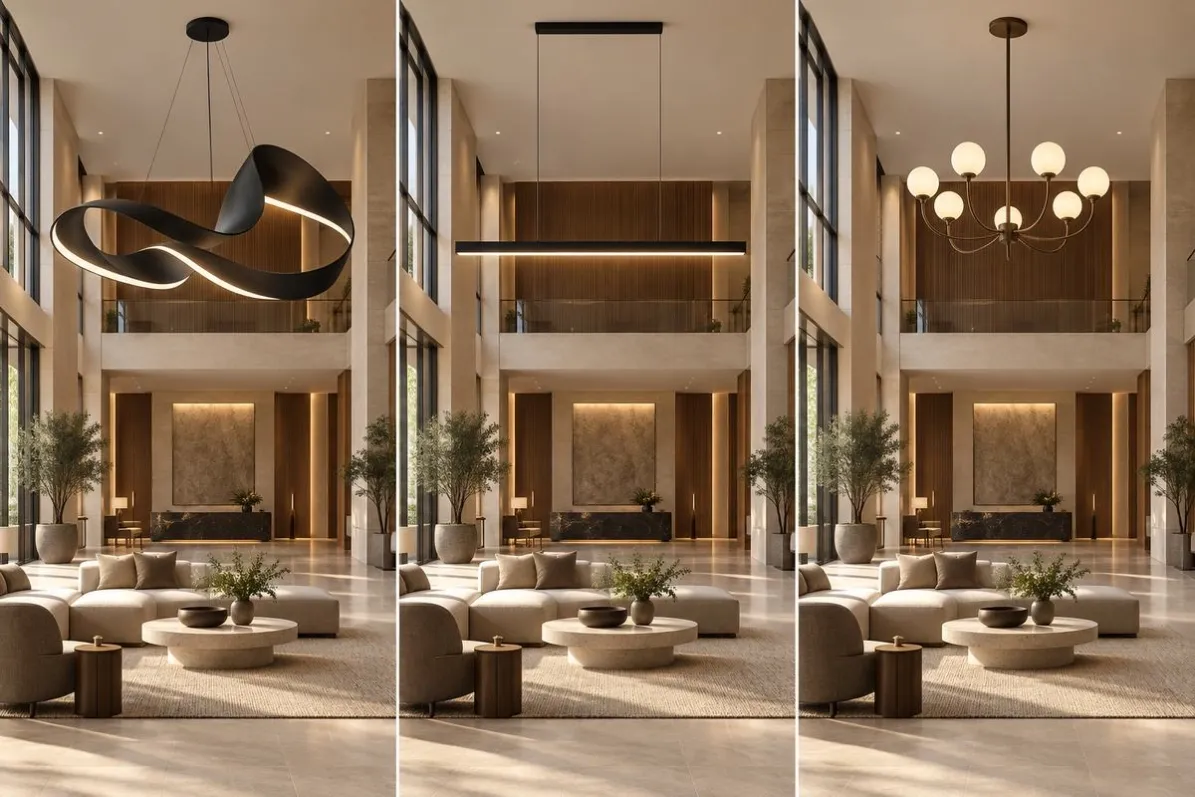
Ceiling lights in a guestroom are usually chosen for how little attention they draw, so their relationship to the ceiling plane matters more than their appearance. A fixture that sits proud of a flat ceiling reads as an applied object; one that sits flush reads as part of the architecture. Neither is wrong, but the choice should be deliberate.
This is also where coordination is easiest to overlook. A recessed or flush ceiling light looks fine on its own sample and can clash badly with the ceiling design once the reflective ceiling is installed. Confirm the ceiling type and its finish before the fixture is ordered.
Build a Package That Can Be Sourced and Checked
Group the required fixtures by room type and quantity, then confirm which products are standard selections and which need customization. This makes quotation, sample review and quality-control planning far more practical, because a standard selection and a custom piece follow different approval paths and should not be waiting on each other.
The same approach works when part of the package is custom hospitality lighting A guestroom package example is covered in our category guide.developed for the project. In practice the most reliable split is: standard categories where the specification is already decided, and custom work only for the positions that need to match a design intent the catalogue cannot meet.
MOER Lighting can support mixed-category sourcing when a project is not suited to a single factory catalog, which is common when a property mixes existing fixtures with new guestroom lighting.
Confirm What Is Fixed Before Ordering
Before the package is released, confirm the details that are expensive to change later: the finish family for each category, the switch and socket standards for the destination market, the lamp holder and control arrangement, and the quantity per room type. A specification that leaves these open will produce samples that differ from the final order, and the revision cost falls on the schedule rather than the budget.
It is also worth recording which items are confirmed and which are still open, so that sampling can begin on the confirmed items without waiting for the full set. When a floor is phasing in over several months, that distinction determines whether the first rooms can be finished on time.
Plan the Package and Then Ask Questions
A guestroom lighting package is easier to source and evaluate when the visual concept and the technical requirements arrive together. If you are assembling a package for a property or a room type, send us the room layout, quantities, destination market and required dates. We can confirm which positions are standard selections, which need customization, and where a specification gap would show up later as a sampling revision.