Oct 8, 2026Custom Lighting
What to Confirm Before Making a Custom Lighting Sample
The essential details that help reduce revisions when turning a reference image or drawing into a physical sample.

A reference image can communicate the overall look of a fixture, but it cannot define every production detail. The samples that cause the most revisions are usually not the samples that were approved; they are the ones where what was agreed and what arrived turned out to be different things. This guide covers what to settle before a physical sample is made, so that approval is a real decision rather than an impression.
Define What Must Match
Start by separating the features that define the design from the features that are open to interpretation. The silhouette, the proportion of each element, the finish tone, the shade material and the mounting method are usually the features a client recognizes and approves. The precise thread pattern inside a shade, the exact tone shift across a large surface, or the spacing between repeated components are usually open to adjustment.
Write both lists down. A clear list of essential features protects the design intent; a clear list of flexible features gives a supplier room to propose something that works technically without losing the look. Projects where these two lists were never separated tend to stall during sampling, because each side assumes the other has already decided.
A useful test: if a client would immediately notice the difference in a photograph of the finished room, the feature belongs in the essential list. If they would only notice it under close inspection, it probably belongs in the flexible list.
Separate Design Requirements From Production Reality
Some design ideas are achievable in custom production; others are achievable only at a cost or in a different form. Proportion is usually negotiable. A complex glass structure, a very thin wall section, or an unusually heavy frame may require a different construction method than the reference image implies. Raising this before the sample protects the schedule.
Non-negotiable requirements should be listed as such. For most hospitality projects that means the general form, the finish family, the light output target and the mounting type. Everything else is a conversation. This distinction matters because a supplier who is told that every detail is fixed will quote a very different price and lead time from one who understands the actual constraint.
Add the Electrical and Market Requirements
Technical requirements travel with the visual ones and are often missed at the concept stage. Specify the destination market, voltage, plug type and lamp holder. State any required control system, dimming protocol, USB or socket arrangement, and whether the fixture must be supplied with a replaceable light source or an integrated module.
These requirements affect the component route, the certification path and sometimes the visual design itself. A control position that is easy to reach in a rendered elevation can be unreachable once the fixture is installed above a lobby reception desk. Confirming electrical and market requirements early keeps that kind of conflict out of the sample stage.
If certification or testing is required for the destination market, state it at the beginning so the appropriate supplier and component route can be evaluated. Retrofitting compliance after a sample is built usually means rebuilding it.
Agree How the Sample Will Be Reviewed
Decide in advance what the sample has to prove and who reviews it. A finish sample confirms color and surface quality but says nothing about scale. A representative illuminated section confirms light distribution but not the complete silhouette. A full prototype confirms proportion and presence, but costs more and takes longer. Agreeing which level is appropriate prevents both directions of waste: approving a finish sample for a question it cannot answer, or paying for a full prototype to settle a color question.
Also agree what will be recorded. Specify which photographs should be taken, which measurements matter, and which functional checks will be performed with the light on and off. Consolidated comments in one revision list keep communication clear and make it obvious when the sample has moved far enough from the original intent to require a fresh conversation.
Check Proportion Against a Real Installation Height
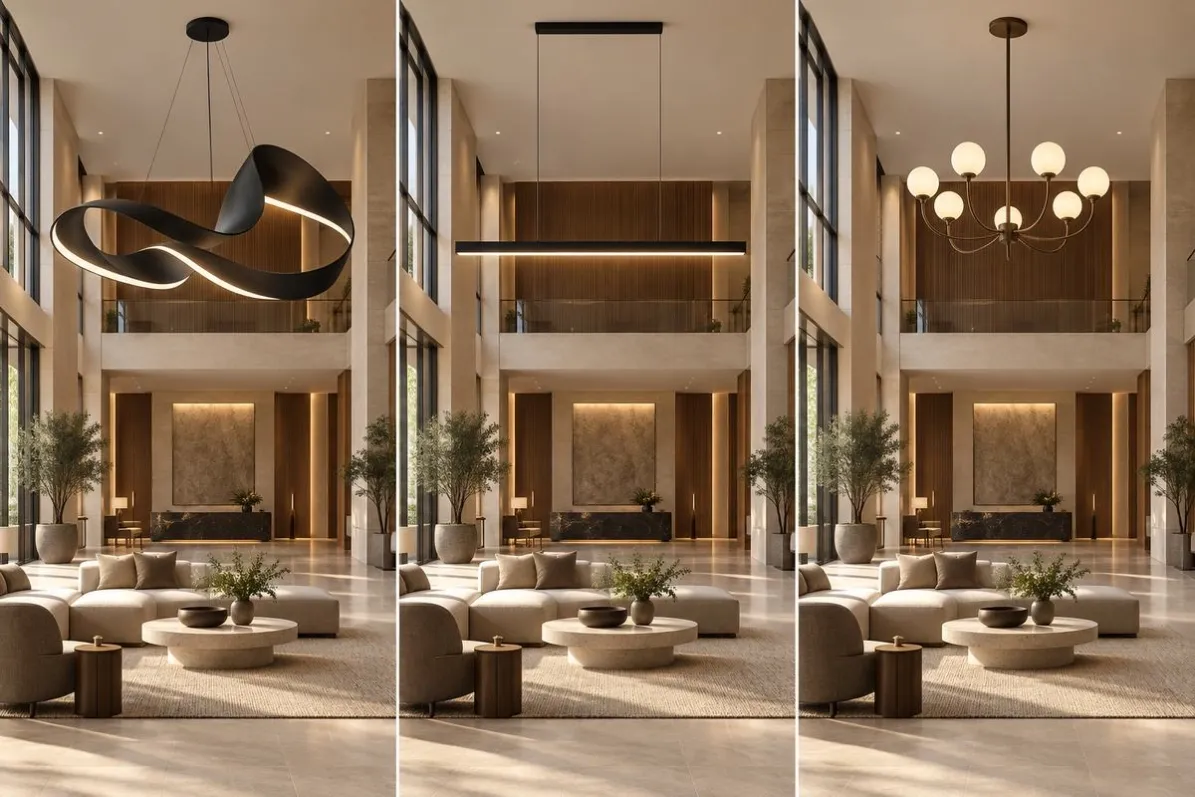
A sample viewed on a table in a factory cannot tell you whether a pendant will look right in a six-metre lobby. Proportion depends on drop length, ceiling height and viewing distance, and it is the most common reason an approved fixture is later judged as too small or too dominant on site.
For the largest statement pieces, ask for scaled views from the entrance and the seating area rather than a product photograph. Where a form is complex enough that flat drawings cannot show the conflict, a simple three-dimensional study often reveals issues that a rendering does not. Our guide to defining a hotel lobby with one statement pendant covers how scale decisions are usually made for a sculptural fixture in a double-height space.
Confirm Maintainability Before the Sample Is Built
Ask how the finished fixture will be cleaned and how its light source or driver will be reached. Magnetic fittings, accessible diffusers and replaceable modules can be specified at the design stage; adding them later often means changing the whole assembly. For fixtures destined for high-traffic hospitality spaces, this is a question the operating team will ask during handover, so it is cheaper to answer now.
This is also where the maintenance discussion intersects with the wider specification. Our article on why one hotel project chose a replaceable bulb over a better-looking LED fixture sets out the lifecycle argument in detail, and our note on easy LED module and driver replacement covers the service access question specifically.
Keep the Sample Specification in the Project File
A sample becomes useful only if the approved version is recorded. Store the confirmed drawing, the finish reference, the agreed dimensions and any marked-up revision notes together, and record the date and the project quantity the sample represents. Without that record, production can drift from what was approved, and there is no reliable way to show what was agreed.
Production should then follow the approved sample and the final specification, with any change documented before work proceeds. A configuration of hospitality pendant lights that has already been approved at sample stage should not reopen during production unless the project itself changed.
Bring the Brief Together Before Approving
A custom hotel lighting brief works best when the visual concept and the technical requirements arrive as one package rather than in separate threads. Once the sample scope, the certification position, the production schedule and the approval responsibilities are all visible at the same time, both sides can judge whether the project is ready to move forward.
MOER Lighting supports custom hospitality lighting sourcing, specification review and sample coordination. If you are preparing a brief, or need to know which configurations can be sampled within a given schedule, send us your concept, dimensions, destination and required date. You can also review our custom lighting manufacturing process to see how a confirmed sample moves into production, inspection and shipment.